EV Charging Extension Cable: How Many mm², Which Connector, How Many Metres?
One of the most common problems in electric car charging is distance: the socket is at one end of the garage, the car at the other, and the charging cable will not reach. At this point the first solution that comes to mind is usually the power strip or cable reel from the house — but charging is a different kind of load from the other appliances at home.
A kettle draws high current for a few minutes. Electric car charging, on the other hand, draws the current the device allows for hours, almost without interruption. That continuity explains why the cross-section and the quality of the connector are so critical in an extension cable.
Why is a household power strip not suitable?
- Thin cross-section: in household extensions the conductor cross-section is usually around 1–1.5 mm²; as it is not designed for continuous high current, it heats up.
- Coiled reel: while the cable is wound on the reel the heat cannot escape. If a reel is to be used, it must be unwound completely.
- Weak contact: the contact surfaces of power strips are not sized for repeated high current; a loose contact generates heat.
- No protection rating: household extensions carry no sealing rating for outdoor use.
We covered the general safety side of home charging (residual current device, dedicated line, qualified electrician) in a separate guide; this article focuses on how to choose the right product.
Four things to look at in the right extension cable
- Cross-section (mm²) — determined by the current to be drawn.
- Connector type — industrial CEE or standard Schuko.
- IP protection rating — will the cable stay outdoors.
- Length — how much distance you actually need.
Cross-section: chosen according to the current
The cross-section is the main variable that determines the current a cable can carry. The cross-sections used in Bemis portable extension cables are split by the current class the cable is designed for as follows:
| Current class | Cross-section | Typical use |
|---|---|---|
| 16 A single-phase | 3 × 2.5 mm² | Portable charger, Schuko/CEE 16 A lines |
| 32 A single-phase | 3 × 6 mm² | High-current single-phase CEE lines |
| 16 A three-phase | 5 × 2.5 mm² | Three-phase 16 A CEE connections |
| 32 A three-phase | 5 × 6 mm² | Three-phase 32 A CEE connections |
The logic here is simple: as the current rises, the cross-section grows. Extending a line that will draw 32 A with a 2.5 mm² cable means running the cable beyond the limit it was designed for.
Connector: why CEE?
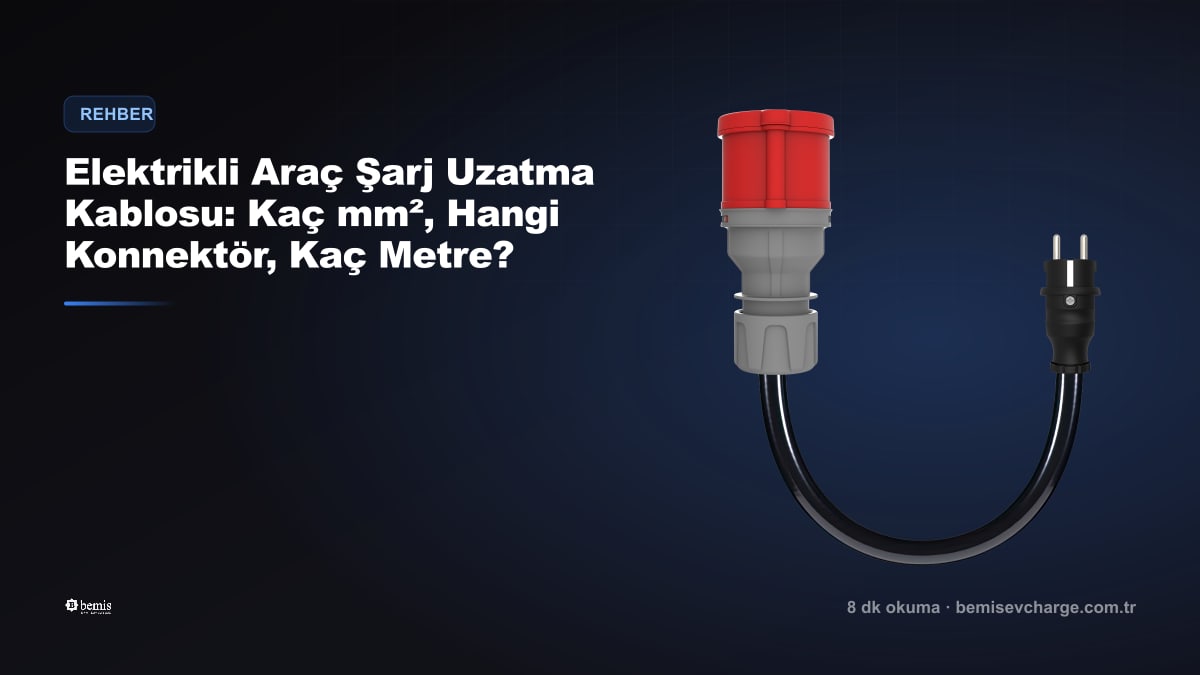
Unlike a standard household socket, CEE (industrial type) plugs and sockets use a locking, gasketed design. This both keeps the contact resistance low and makes it harder for the cable to come out accidentally. Bemis extension cables come in 16 A and 32 A CEE configurations; there are also CEE-norm converter adapters that switch between different plug–socket combinations.
The cable ends are clearly stated in the product name: for example "1/16A Plug → 3/32A Socket" means going from a single-phase 16 A plug to a three-phase 32 A socket. Before buying, check the input and output type of the equipment you already have.
IP rating: will the cable stay outside?
A cable that stays in a closed garage does not need the same protection as one exposed to rain in the garden. The standard range of Bemis portable extension cables carries an IP44 rating; it is protected against splashing water. For harsher outdoor conditions there is a 10 metre IP68 model — IP68 means a class that is fully dust-tight and also protected against immersion in water.
The protection rating must be considered not only for the cable itself but also for the points where connections are made: a joint left exposed makes the cable's IP rating meaningless in practice.
How many metres do you need?
An extension cable does not always have to be the first solution. If your charging cable is too short, buying a longer charging cable is in most cases the cleaner solution: Bemis Type 2 charging cables are produced in lengths of 3, 5, 7, 8, 10 and 15 metres. That way no extra connection point is created.
An extension cable, on the other hand, makes sense for carrying the supply side — for example to reach the plug of your portable charger to a distant CEE socket. Bemis extension cables are offered in 5 and 10 metre options. Since the voltage drop along the line increases with length, choosing a cable longer than you need brings no advantage.
Bemis portable extension cables
| Connection | Length | Cross-section | Protection |
|---|---|---|---|
| 1/16A Plug → 1/16A Socket | 5 m / 10 m | 3 × 2.5 mm² | IP44 |
| 1/16A Plug → 1/16A Socket | 10 m | 3 × 2.5 mm² | IP68 |
| 1/16A Plug → 3/32A Socket | 5 m / 10 m | 3 × 2.5 mm² | IP44 |
| 1/16A Plug → 5/32A Socket | 5 m / 10 m | 3 × 2.5 mm² | IP44 |
| 3/32A Plug → 3/32A Socket | 5 m / 10 m | 3 × 6 mm² | IP44 |
| 5/16A Plug → 5/16A Socket | 5 m / 10 m | 5 × 2.5 mm² | IP44 |
| 5/32A Plug → 5/32A Socket | 5 m / 10 m | 5 × 6 mm² | IP44 |
All models are produced in our own facility in Bursa; they are CE certified and hold the Domestic Goods Certificate with a 94% local content ratio. If you are unsure about the connection type, it is enough to tell us the plug type of your equipment and the current it will draw — we can determine the right model together.
See the full range of extension cables and converter adapters.
Extension Cables and AdaptersFrequently Asked Questions
Can I extend the charging cable of my electric car?
Extending the charging cable itself by splicing is not the right method; every additional point means a new contact resistance and a new weak link. There are two sound routes: buying a charging cable of the length you need (Bemis Type 2 cables are produced between 3 and 15 metres) or carrying the supply side with a portable extension cable of the correct cross-section and the right connector. With the second method the cable's cross-section must match the current to be drawn and the connection points must be protected against the elements.
Can I use a household power strip or a cable reel for charging?
Household power strips and reels are not designed for high current lasting hours. Their conductor cross-sections are usually thin, their contact surfaces are not sized for continuous load and they carry no outdoor protection rating. Reels have one further problem: the heat produced while the cable is coiled cannot escape, so if one is used it must be unwound completely. If you need to extend the charging supply, the right approach is to use an extension cable made for this purpose with a suitable cross-section and protection rating.
How many mm² should an extension cable be?
The cross-section is determined by the current the cable will carry. In Bemis portable extension cables, 2.5 mm² is used for 16 A class connections and 6 mm² for 32 A class connections; in three-phase models the number of cores rises to five (5 × 2.5 mm² or 5 × 6 mm²). The practical rule is this: as the current rises, the cross-section grows. If you do not know the current you will draw, you can look at the maximum current value on the label of your portable charger or charging unit, and ask us whenever you are not sure.
Can I use the extension cable outdoors, in the rain?
That depends entirely on the protection rating. The standard range of Bemis portable extension cables is IP44 rated and protected against splashing water. For harsher outdoor conditions there is a 10 metre model rated IP68, fully dust-tight and protected against immersion in water. Remember that the protection rating must cover not only the cable but also the points where the connection is made: a joint left exposed makes the cable's own protection rating void in practice.
Does an extension cable reduce charging speed?
An extension cable chosen with the correct cross-section does not by itself reduce the charging power; the main factors that determine charging speed are the vehicle's onboard charger, the capacity of the supply line and the current setting of the charging device. However, the longer the cable, the greater the voltage drop along the line, and if the cross-section is insufficient this drop becomes noticeable. So choosing a cable longer than you need brings no benefit; the best choice is the shortest model that covers the distance with a cross-section matched to the current.