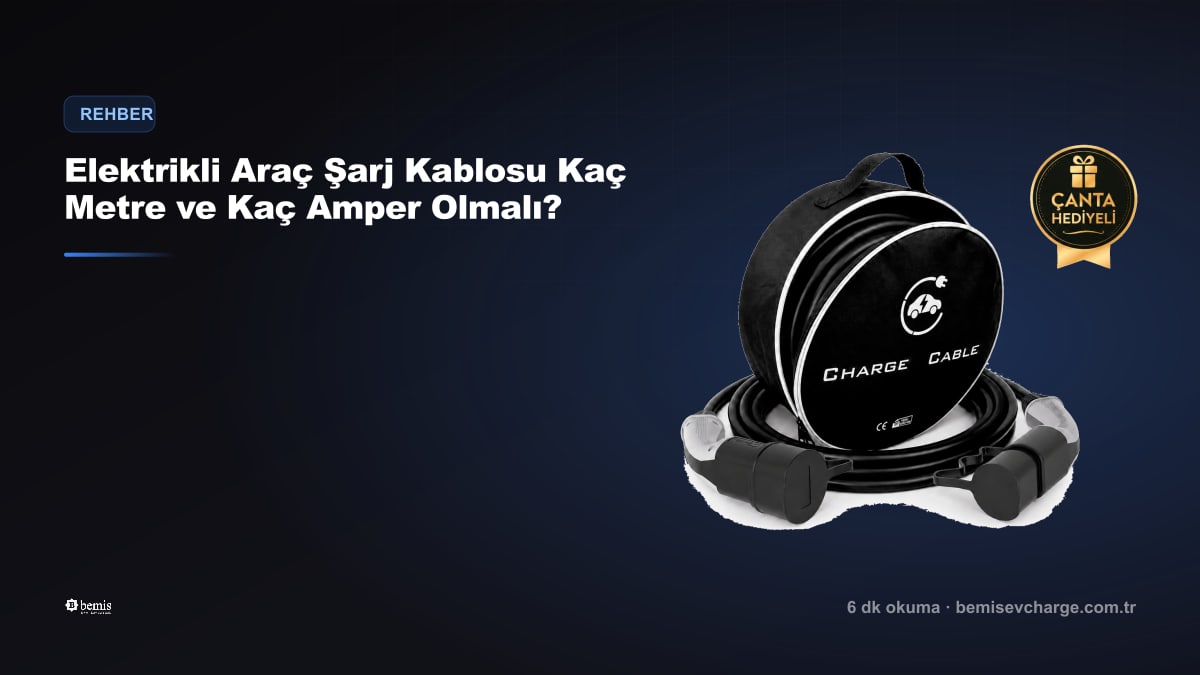
How Many Metres and How Many Amps Should an EV Charging Cable Be?
The two questions most often asked when buying an electric vehicle charging cable: how many amps (how many kW) and how many metres? The right answer depends on the charging power your car can accept and where you park it. In this guide we clarify both with examples.
Short answer
- For most home users: a 32A, 5–7 metre Type 2 cable is ideal.
- If your home is single-phase, 32A gives you up to 7.4 kW of charging.
- If your home/workplace is three-phase and your car supports it, 22 kW is possible with 32A.
- If the car parks close to the socket, 5 metres is enough; if the socket is far, choose 7–10 metres.
How many amps should it be? (16A or 32A?)
The amperage determines the current the cable can carry — that is, the charging power. There are two common values: 16A and 32A. The corresponding power figures by number of phases are as follows:
- Single-phase (~230V): 16A ≈ 3.7 kW · 32A ≈ 7.4 kW
- Three-phase (~400V): 16A ≈ 11 kW · 32A ≈ 22 kW
But no matter how powerful the cable, the real charging speed is limited by the AC charging unit inside your car (the onboard charger). For example, if your car accepts a maximum of 11 kW AC, it will charge at 11 kW even with a 22 kW cable. So the real question is: 'how many kW of AC charging does my car accept?' If you're not sure, a 32A cable is the safe choice; it's enough for both your current and your future car.
How many metres should it be?
Length is entirely a matter of practicality. The standard options are 5, 7 and 10 metres:
- 5 metres: enough if you park close to the charging unit/socket; the most compact and affordable.
- 7 metres: the most balanced choice — a comfortable distance for most garage and car-park layouts.
- 10 metres: if the socket is far away, if you park the car facing the other way, or if you want flexibility in a shared car park.
Buying a longer cable than you need does no harm, but it's heavier, more expensive and more of a hassle to coil up. One or two metres more than you need makes an ideal buffer.
Single-phase or three-phase?
This depends on both your car and your electrical installation. Most homes have single-phase electricity; in that case you get a maximum of 7.4 kW (32A). At a workplace, residential-complex car park or a home with a three-phase supply, if three-phase is available and your car supports it, you can go up to 22 kW. Before choosing a cable, it's best to have an electrician confirm how many phases your installation has.
Summary: choose the right cable in 3 questions
- How many kW of AC charging does my car accept? → this determines the amperage you need (32A is generally safe).
- Is my installation single-phase or three-phase? → this sets the ceiling: single-phase 7.4 kW / three-phase 22 kW.
- How far do I park my car from the socket? → 5, 7 or 10 metres.
Bemis Type 2 charging cables are locally manufactured, with 16A/32A, single-phase and three-phase, and 5–10 metre options.
Explore Charging CablesFrequently Asked Questions
How many amps should an electric vehicle charging cable be?
The two most common values are 16A and 32A. On a single-phase installation, 16A delivers about 3.7 kW and 32A about 7.4 kW; on a three-phase installation, 16A reaches about 11 kW and 32A about 22 kW. However, no matter how powerful the cable, the real charging speed is limited by the AC charging unit inside your car (the onboard charger). So first check how many kW of AC charging your car accepts. If you're not sure, a 32A cable is the safe choice; it offers enough capacity for both your current and your future car, and it works without issue on lower-power cars too.
Is a 5-metre charging cable enough?
If you park your car close to the charging unit or socket, 5 metres is enough for most home use; it's the most compact and affordable option. However, if the socket is in a far corner of the garage, if you sometimes park the car facing the other way, or if you want flexibility in a shared car park, 7 metres is the most balanced choice. If the socket really is far away, choose 10 metres. The general rule: add a 1–2 metre buffer to the distance you need. A longer cable than necessary works, but it's heavier, more expensive and more of a hassle to coil up.
What is the difference between a 16A and a 32A charging cable?
The difference is in the current the cable can carry and therefore the charging power. A 32A cable carries roughly twice the power of a 16A one: on a single-phase installation 16A ≈ 3.7 kW while 32A ≈ 7.4 kW; on a three-phase installation 16A ≈ 11 kW while 32A ≈ 22 kW. In other words, a 32A cable offers the potential to charge your car in less time. But to realise that potential, both your installation and your car must support that power. If your car is lower-powered, a 32A cable still works — it simply charges at the car's limit.
Can a three-phase cable be used on a single-phase car?
Yes, it can. The Type 2 connector is the same for both single-phase and three-phase, so there's no physical incompatibility when a three-phase cable is plugged into a single-phase car or a single-phase installation. In that case, charging takes place at the lowest capacity in the system: if your car or your installation is single-phase, power stays limited to 7.4 kW (32A), and the cable being three-phase brings no extra speed. So a three-phase cable is a safe, future-proof investment; if you later move to a three-phase installation or car, you can carry on using the same cable.