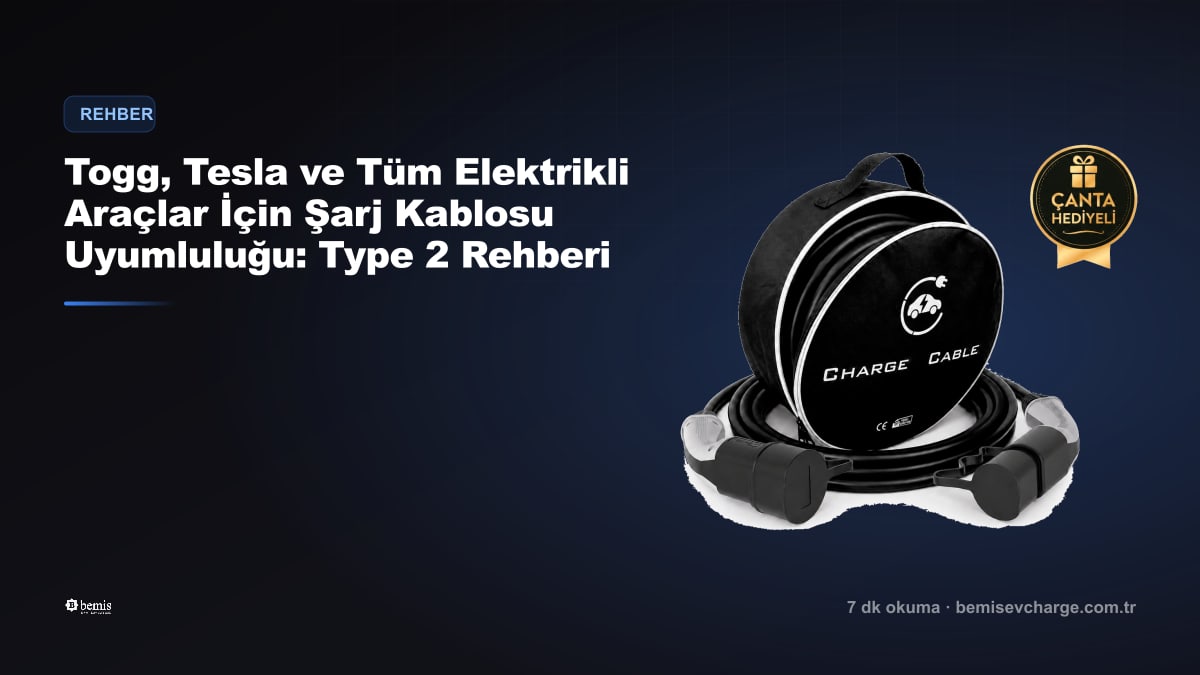
Charging Cable Compatibility for Togg, Tesla and All Electric Cars: The Type 2 Guide
Short answer: all new electric cars sold in Türkiye and Europe — Togg, Tesla, Hyundai, Kia, Renault, BMW, Mercedes, Volvo, BYD and the rest — use the same standard inlet for AC charging: Type 2 (IEC 62196-2). That is why a Type 2 — Type 2 charging cable is compatible with all of these cars. The worry "will this cable fit my car?" largely disappears thanks to this single standard, whatever the brand.
Even so, the question is always asked by brand: "which cable for a Togg?", "does Type 2 fit a Tesla?", "which cable should I buy for the car I have just bought?" This guide is not a technical encyclopedia of connector types; it is a practical checklist that settles the owner's compatibility worry. Answers specific to Togg and Tesla, a brand-by-brand summary table, the Mode 2 / Mode 3 distinction, amperage and phase selection and the marks to look for before buying — all on one page.
Which charging cable fits a Togg?
The AC charging inlet of the Togg T10X is Type 2. The cable you will use when charging from a wallbox at home or from a public AC station is a Type 2 — Type 2 Mode 3 charging set. One important practical detail: at most public AC stations the cable is not included with the station and the driver plugs in their own. That is why keeping a Type 2 cable in the boot of your Togg is not just a convenience but effectively a necessity.
The capacity is chosen according to the installation. If you have a three-phase line and a three-phase wallbox at home, a 16 A three-phase cable does justice to 11 kW installations and a 32 A three-phase cable to installations up to 22 kW. On a single-phase line, a 32 A single-phase set is enough for up to 7.4 kW. The maximum power your car accepts on AC charging is stated in the owner's handbook; the cable should be chosen with the capacity to carry that value. If you are undecided, a 32 A three-phase set is the most flexible choice: it works without any problem on a lower-power installation today, and you will not have to replace it when you increase the power tomorrow.
Which charging cable fits a Tesla?
The answer to "is a Tesla compatible with a Type 2 cable?" is clear: yes. Teslas built for the European market and sold in Türkiye — including the Model 3 and the Model Y — use the standard Type 2 inlet for AC charging. You do not need to look for a separate "Tesla cable"; a CE marked, IEC 62196-2 compliant Type 2 — Type 2 cable works without any problem with a Tesla on a home wallbox and at public AC stations.
Two notes. First: the different connection standard used in the US market (NACS) does not apply to the Teslas sold in Türkiye; the cars here come with European equipment. Second: in DC fast charging — including Superchargers — the cable is always fixed to the station and you do not use your own. Your portable Type 2 cable is only for AC charging. You can find our detailed guide on charging a Tesla in Türkiye among the related articles.
AC charging inlet brand by brand: all Type 2
The table below summarises the AC charging inlet of the most frequently asked-about brands. The rule is deliberately simple: on new electric cars offered for sale in the Turkish and European markets, the AC inlet standard is Type 2. The same rule applies to brands you do not see in the table.
| Brand (example models) | AC charging inlet | Type 2 cable compatibility |
|---|---|---|
| Togg (T10X) | Type 2 | Compatible |
| Tesla (Model 3, Model Y) | Type 2 | Compatible |
| Hyundai / Kia (Ioniq 5, EV6...) | Type 2 | Compatible |
| Renault / Fiat / Peugeot / Opel | Type 2 | Compatible |
| BMW / Mercedes / Audi / Volkswagen | Type 2 | Compatible |
| Volvo / MG / BYD | Type 2 | Compatible |
The only exception belongs to the past: some models sold in the early 2010s used a different AC inlet called Type 1. You will not come across this on a new car; if you are buying an older second-hand vehicle, it is enough to open the charging flap and look — the 7-pin round Type 2 inlet is easy to recognise. We have a separate guide covering all connector types in detail (including CCS2 and CHAdeMO on the DC side); the focus of this article is AC cable compatibility.
Mode 2 or Mode 3? From a socket or from a wallbox?
The second concept you meet when looking for a cable is the "Mode", and the answer depends on where you will charge:
- Mode 3 — the wallbox and AC station cable: this is the Type 2 — Type 2 cable used between the charging station and the car. The signalling is handled by the station and the connector is mechanically locked throughout charging. The charging cables that are the subject of this guide are in the Mode 3 class (IEC 61851-1).
- Mode 2 — not a cable but a portable device: to charge from a household socket a portable charger with a protection and control box on it is used; that box provides safety between the plugged-in side and the car.
In practice: if your wallbox is the socketed (untethered) type you will also need to buy a Mode 3 Type 2 cable; if it is the tethered type the cable is already on the device. We compared the question of a wallbox or a portable charger at home in detail in a separate guide.
How many amps, how many phases? The simple rule that sets charging speed
Type 2 compatibility guarantees the physical connection; the charging speed, however, is set by the lowest of three values: your car's AC acceptance rate, the station's power and the cable's carrying capacity. Cables are referred to by their phase and current values; the equivalents can be summarised as follows:
- Single-phase 16 A → 3.7 kW · Single-phase 32 A → 7.4 kW
- Three-phase 16 A → 11 kW · Three-phase 32 A → 22 kW
- If the cable's capacity is above what you need it causes no problem; if it is below, the charging speed drops to the cable's limit.
The question of how many metres is a similar balance: a short cable restricts your parking position, while an unnecessarily long one adds the burden of carrying and coiling it. You can find all the details of choosing length and amperage — with home wiring, use scenarios and examples — in our guide "How Many Metres and How Many Amps Should a Charging Cable Be?".
What to look out for when buying a charging cable
Once compatibility is confirmed, it is the turn of the quality and safety marks. We recommend checking the following points before buying:
- CE marking and conformity testing: the basic indication that the cable has been tested to the relevant standards.
- An IEC 62196-2 compliant Type 2 connector: provides a standard connection with no trouble on the car and station side.
- Mode 3 signalling and mechanical locking (IEC 61851-1): prevents the connector coming out of place during charging.
- Cable cross-section: as the current rises, the conductor cross-section must grow too — for example, 2.5 mm² is used in 16 A sets and 6 mm² in 32 A sets.
- Outer sheath durability: a halogen-free cable structure resistant to UV and weather extends the life in outdoor use.
- IP protection rating: if the cable will often be used outdoors, confirm the protection rating of the connectors from the manufacturer's documents.
The Bemis Type 2 charging cable families
Bemis produces Type 2 — Type 2 Mode 3 charging sets in four main capacities. All the sets use an IEC 62196-2 connector, mechanically locking Mode 3 signalling (IEC 61851-1), a flexible copper conductor and a halogen-free outer sheath resistant to UV and weather; the sets pass CE conformity testing. In other words, they are compatible with all the cars in the table — from Togg to Tesla.
| Set | Phase / Current | Power | Cable cross-section | Length options |
|---|---|---|---|---|
| Charging Set 16 A Single-phase | Single-phase / 16 A | 3.7 kW | 3×2.5 mm² + 1×0.75 mm² | 3 / 5 / 7 / 8 / 10 m |
| Charging Set 32 A Single-phase | Single-phase / 32 A | 7.4 kW | 3×6 mm² + 1×0.75 mm² | 3 / 5 / 7 / 8 / 10 m |
| Charging Set 16 A Three-phase | Three-phase / 16 A | 11 kW | 5×2.5 mm² + 1×0.75 mm² | 3 / 5 / 7 / 8 / 10 / 15 m |
| Charging Set 32 A Three-phase | Three-phase / 32 A | 22 kW | 5×6 mm² + 1×0.75 mm² | 3 / 5 / 7 / 8 / 10 / 15 m |
To compare the length and capacity that suit your car, take a look at our product page.
See the Type 2 Charging CablesFrequently Asked Questions
Which charging cable fits a Togg T10X?
The Togg T10X, like all new electric cars in Türkiye and Europe, uses a Type 2 inlet for AC charging; a Type 2 — Type 2 Mode 3 charging cable is compatible with the T10X. If you have a three-phase wallbox at home, a 16 A three-phase cable does justice to 11 kW installations and a 32 A three-phase cable to installations up to 22 kW; on a single-phase line a 32 A single-phase set is enough for up to 7.4 kW. The maximum power the car accepts on the AC side is stated in the owner's handbook; the cable should be chosen with the capacity to carry that value. Since you plug in your own cable at most public AC stations, keeping a Type 2 cable in the car is a practical necessity for Togg owners.
Is a Type 2 cable compatible with a Tesla Model 3 or Model Y?
Yes. Teslas built for the European market and sold in Türkiye — including the Model 3 and the Model Y — use the standard Type 2 inlet for AC charging. A Type 2 — Type 2 Mode 3 charging cable therefore works without any problem with a Tesla on a home wallbox and at public AC stations; you do not need to look for a separate "Tesla cable". The different connection standard in the US market (NACS) does not apply to the cars sold in Türkiye. In DC fast charging — including Superchargers — the cable is fixed to the station; you do not use your own. A good-quality CE marked, IEC 62196-2 compliant Type 2 cable is all your Tesla needs.
How do I tell whether a charging cable fits my car?
Three checks are enough. First the connector: the AC inlet of all new electric cars sold in Türkiye and Europe is Type 2; if the car side of your cable is Type 2, the physical fit is settled. Second the power: the maximum value your car accepts on AC charging is stated in the owner's handbook, and the cable's phase and current capacity should be able to carry that value. If it cannot, no danger arises; charging simply takes place at the cable's limit. Third the documents: CE marking together with IEC 62196-2 and IEC 61851-1 conformity is the sign of safe manufacturing. The only exception is some older models with a Type 1 inlet from the early 2010s; if you are buying an older second-hand car, open the charging flap and confirm the 7-pin round Type 2 inlet by eye.
My car accepts 11 kW; will there be a problem if I buy a cable rated at 22 kW?
No, there will not be a problem — on the contrary, it gives you flexibility. The charging power is always set by the weakest link in the chain: if your car accepts 11 kW, charging takes place at 11 kW even with a 32 A three-phase cable that can carry 22 kW. The cable does not "push extra power" into the car; it only defines the upper limit it can carry. The advantage of a higher-capacity cable is being ready for the future: if your next car or your new wallbox supports 22 kW AC, you carry on using the same cable. The case to watch is the reverse: if the cable's capacity is below that of the car and the station, the charging speed drops to the cable's limit. The most sensible approach is to choose the cable not for today's installation but for your needs over the next few years.