How to Choose a DC Charging Cable and CCS2 Connector
On a DC fast charging station the part that wears out most is not the unit itself but the cable the vehicle plugs into. DC cables are heavy; they fall to the ground when the user lets go, vehicles drive over them, and they are strained when pulled from the holster. That is why a station goes through several cable sets over its lifetime. This article explains how to choose the right CCS2 set, both for a new unit and for a cable being replaced in the field.
Are a DC charging cable and a CCS2 connector the same thing?
In the field both names are usually used for the same product. CCS2 (Combined Charging System 2) is the interface defined under IEC 62196-3 and the standard for DC fast charging in Europe. "Connector" or "socket" refers to the end the vehicle plugs into, while "DC charging cable" refers to the set formed by that connector and the cable. Because the product appears in the catalogue as a single item, both searches lead to the same entry.
First decision: the current rating
The most decisive value in the selection is the current rating, and it is determined by the output current of the unit the cable will be connected to. Choose a rating equal to or higher than the current stated on the unit's label; never fit a cable rated below the unit's output current. The Bemis catalogue offers four ratings:
- 80 A — DC units in the low power class
- 150 A — medium power class
- 250 A — high power class
- 400 A — the top class
Estimating the rating from the unit's kW figure does not give a correct result: the same power means a different current at different voltage levels. The criterion is therefore always the output current on the unit's label.
Second decision: cable length
The catalogue offers 5 and 8 metre options. The length is chosen according to the distance between the unit and the point where the vehicle will park, and according to how the cable is held. If vehicles pull up on both sides of the unit, or the parking space is far from it, 8 metres is preferable. On the other hand, a cable longer than needed drags on the ground more and therefore wears faster; choosing a long one "just in case" is not always an advantage.
Third decision: how will the end be terminated?
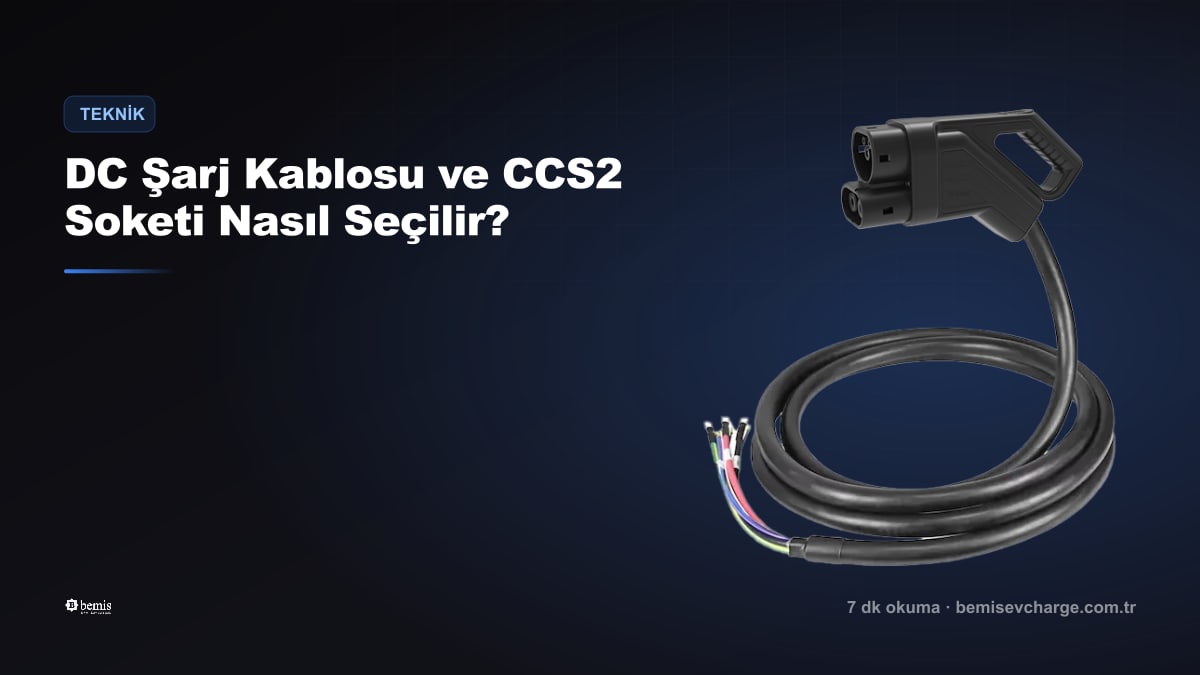
The CCS2 cable sets produced by Bemis are delivered "open-ended". The end the vehicle plugs into carries a factory-terminated CCS2 connector; the end on the unit side is left open and is terminated directly to the unit's own power connection. No intermediate connecting element is needed. This makes the cable set adaptable both to new units on the production line and to existing units in the field; the termination is made according to the unit's own design.
When does a cable need replacing in the field?
The symptoms below indicate that the cable set should be inspected or replaced. In almost all of them the unit itself is sound; the only thing that needs changing is the cable.
| Symptom | What it may mean | What to do |
|---|---|---|
| A crack or break in the connector body | Being dropped or driven over by a vehicle | The cable set is replaced; do not attempt charging with a cracked body |
| The connector is hard to remove from the vehicle, the lock sticks | Damage or dirt in the locking mechanism | Do not pull by force; report the unit to authorised service |
| Crushing, cuts or scuffs in the cable sheath | Pinching, dragging, vehicles driving over | The cable set is replaced |
| The connector body becomes unusually hot | A connection or contact problem | Stop charging and call authorised service |
| Charging keeps stopping by itself | Either the cable and connector side or the unit side | First inspect the cable and connector visually; if that brings no result, report to service |
Who should carry out the replacement?
The DC side carries high current and the open end of the cable is terminated to the unit's power connection. For that reason the cable must be replaced by the manufacturer of the unit or its authorised service, in line with the unit's own installation instructions. Noting the unit's output current, the existing cable length and how the open end is terminated inside the unit before the replacement means the right product is identified the first time.
Current ratings, lengths and all product codes on a single page:
DC Charging Cable and CCS2 ConnectorFrequently Asked Questions
Is there a difference between a CCS2 connector and a DC charging cable?
In practice both describe the same product. CCS2 is the name of the interface defined under IEC 62196-3 and the standard for DC fast charging in Europe. "Connector" or "socket" refers to the end the vehicle plugs into, while "DC charging cable" refers to the set formed by the connector and the cable. In the catalogue the connector and its cable appear together as a single item, which is why both searches lead to the same product. To avoid confusion when ordering, it is enough to state the current rating and the cable length together.
How do I know which current rating to choose?
The criterion is the output current of the DC unit the cable will be connected to; that value is stated on the unit's label. The cable rating you choose must be equal to or higher than that value, never lower. The catalogue offers ratings of 80, 150, 250 and 400 amps. Estimating the rating from the unit's kW figure is misleading: the same power corresponds to a different current at different voltage levels. If you are unsure, share the label information of the unit and the values marked on the existing cable, and the correct rating can be determined together.
Should I choose 5 metres or 8 metres?
The length is chosen according to the distance between the unit and the point where the vehicle will park, and according to the holster or guide arrangement of the cable. If vehicles pull up on both sides of the unit, or the parking space is far from it, 8 metres gives more comfortable use. A cable longer than needed, on the other hand, drags on the ground more, so its sheath and connector body wear faster. When renewing an existing unit, the safest approach is to measure the length of the cable being removed and continue with the same value.
If the cable is damaged, does the whole unit have to be replaced?
No. The CCS2 cable set is a replaceable part of the unit. In almost all cases — a broken connector body, a crushed cable sheath or a damaged locking mechanism — the electronics and the housing of the unit are sound; only the cable set is replaced and the unit is put back into service. Because the DC side carries high current, the replacement must be made by the manufacturer of the unit or its authorised service, in line with the unit's own installation instructions.
Can an open-ended cable be used on another manufacturer's unit?
Because the product is delivered open-ended, the termination is made to the power connection of the unit it will be connected to, and that connection differs from unit to unit. For that reason the suitability assessment and the installation must be carried out by the manufacturer of the unit concerned or its authorised service. Once the output current of the unit, the cable length required and how the open end will be terminated are shared, the appropriate rating can be assessed together.