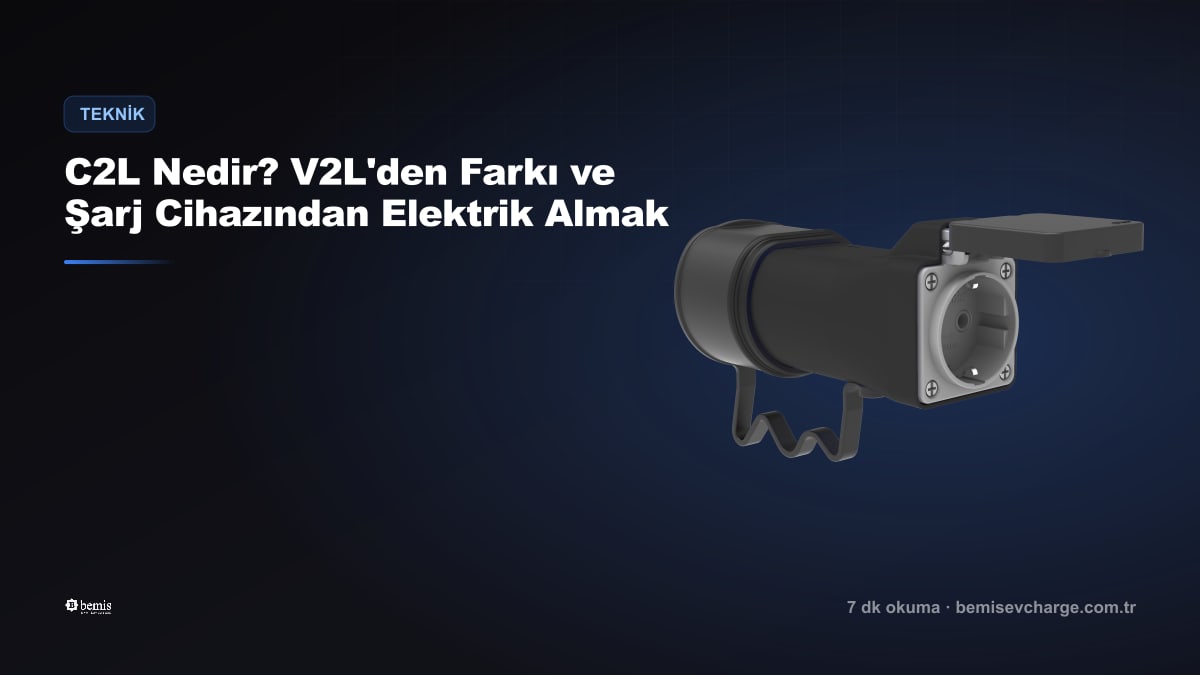
What Is C2L? The Difference from V2L and Taking Power from the Charger
Most people researching a V2L adapter come across C2L at some point and confuse the two. The names look alike, so they are taken for two versions of the same thing; yet their basic difference is WHERE the power comes from. That difference is also what decides which one will do the job for you.
The difference in one sentence
V2L (Vehicle to Load) takes power from the car's battery. C2L (Charger to Load) takes it from the Type 2 output of an AC charging station; so the source is not the car but the charger on the wall and the grid behind it. Both end up giving you a standard socket, but one eats into your car's range and the other does not.
This difference has three practical consequences
- Your car does not need to have V2L. Because C2L connects to the charger, the car does not have to support the feature; in fact there does not even have to be a car present.
- Range is not reduced. Since the power comes from the grid, nothing is drawn from the battery; you find your car charged in the morning.
- Run time is not capped by the battery. With V2L the ceiling is the car's remaining charge; with C2L the source is the grid, so that particular limit disappears.
In return C2L has a condition of its own: an AC charger has to be there. However far the car travels, V2L can be carried with you; C2L works where the charging point is.
Where is it useful?
We see C2L used most where electricity already exists in the form of a charging point but there is no ordinary socket:
- Car parks and site installations: there is a charging unit but no socket on the wall, and lighting, a hand tool or a measuring device needs feeding.
- Workshops and construction sites: a charging point exists and power has to be carried to a temporary work area.
- Events and trade fairs: multiple feeds from a single connection point for a temporary stand, lighting and small equipment.
- Camping and the garden: running devices from the charging point; on the caravan side the C2C adapter takes over.
The forms of the C2L adapter
The input of Bemis C2L adapters is Type 2 (the charger output) and their maximum current is 16A. On the output side there are four options:
| Form | Output | Cable | Typical use |
|---|---|---|---|
| Single-socket extension | 1 socket | 3 m | One device |
| 2-socket extension | 2 sockets | 3 m | Two devices at once |
| 3-socket extension | 3 sockets | 3 m | Site · event · workshop |
| With industrial socket | 5/32A CEE | 3 m | Construction and industrial equipment |
There is also a cable-free version that plugs in directly and carries one outlet. Adding sockets does not add capacity: the total load shares the same 16A ceiling, so do not expect to plug two heaters into two sockets and exceed that limit overall.
C2C: the counterpart on the caravan side
What caravan users are looking for is the C2C (Charger to Caravan) adapter. It adapts the Type 2 output of the charger to the 3/16A industrial connection the caravan is fed from, which makes it possible to power a caravan from a charging point at a campsite. Finding out in advance which connection the campsite offers means you take the right adapter with you.
Which one should you buy?
The decision really comes down to one question: where will the power come from? From your car's battery, V2L; from a charger, C2L; to feed a caravan, C2C. If your car has V2L and you often go where there is no charging point, choose V2L; if you have a fixed charging point and want to preserve your car's range, C2L is the better fit.
Using both is common too: C2L at home or at work, V2L on the road. On the V2L side we explained the connector choice, which is split by brand group, step by step in a separate guide.
Three things to watch
- Do not exceed the 16A ceiling. The adapter carries that current; plan the total load of the devices you connect accordingly.
- The charger itself also sets a limit. If the unit's adjustable current is lower, that is the value which applies.
- Do not confuse it with V2L. C2L has no end on the vehicle side; brand compatibility is not decisive for C2L, because the power does not come from the car.
Explore the full range of V2L, C2L and C2C adapters.
V2L / C2L adaptersFrequently Asked Questions
What is C2L and what is it for?
C2L (Charger to Load) is an adapter that converts the power it takes from the Type 2 output of an AC charging station into a standard socket. It is used to run electrical devices where a charging point exists but an ordinary socket does not: car parks and site installations, workshops and construction sites, events and trade fairs, camping and the garden. Because the power comes from the grid rather than the car, there does not even have to be an electric vehicle present; the adapter connects straight to the charging unit. The input of Bemis C2L adapters is Type 2 and their maximum current is 16A. On the output side there are single, two- and three-socket options on a 3 metre cable plus a version with an industrial 5/32A socket, and also a cable-free version that plugs in directly and carries one outlet.
What is the difference between C2L and V2L?
The difference is where the power comes from. V2L (Vehicle to Load) takes it from the car's battery; C2L (Charger to Load) takes it from the Type 2 output of an AC charging station, that is, from the grid. Both end up giving you a standard socket, but the consequences differ. With C2L your car does not need to support V2L, your range is not reduced and run time is not capped by the car's remaining charge. In return, C2L works where a charger is present; V2L travels with you wherever your car goes. So the two are not rivals but complements: C2L at a fixed point, V2L on the road.
My car has no V2L — can I still take power with C2L?
Yes. Because C2L takes power from the charger rather than the car, your car does not need to support V2L. In fact there does not even have to be a car present during the connection; the adapter plugs straight into the Type 2 output of the charging unit and gives you a standard socket. That is why C2L is the most direct way for owners of cars without V2L to get the same convenience. Its only condition is that an AC charger is available; if you have a fixed charging point at home, at work or in a car park, that condition is already met. And since the power comes from the grid, nothing at all is taken from your car's range.
How many amps can I draw from a C2L adapter?
Bemis C2L adapters carry a maximum of 16A. The limit that actually applies, however, is whichever is lower: that figure or your charger's current setting. If the unit's current is set lower, the power you can draw is lower too. On multi-socket versions the number of sockets does not increase total capacity; every device you connect to two or three sockets shares the same 16A ceiling. So plan the total load up front when you intend to run power-hungry devices at the same time; with heaters, welders and similar high-draw equipment, sticking to one device is the safest approach.
Which adapter do I need to power a caravan from a charging point?
The C2C (Charger to Caravan) adapter is used for this. It adapts the Type 2 single-phase 16A output of the charger, over a 3 metre cable, to the 3/16A CEE connection the caravan is fed from, so you can power your caravan from a charging point at a campsite. It comes from the same family as C2L and likewise takes its power from the charger, not from the car. It should not be confused with V2L: with V2L the source is the car's battery, while with C2C it is the grid. Finding out in advance which connection the campsite offers means you take the right adapter with you and are not left improvising on the spot.
Does the car brand matter when choosing a C2L adapter?
No. C2L has no end on the vehicle side; because the power comes from the charger, the car brand is not decisive when choosing C2L. The brand distinction applies only on the V2L side, where the end that plugs into the car changes by brand and a connector that does not fit will not go in physically. What you look at when choosing C2L is different: how many sockets you want, whether you need an industrial 5/32A socket, whether you will carry the device away from the charging point, and whether your total load stays under the 16A ceiling.