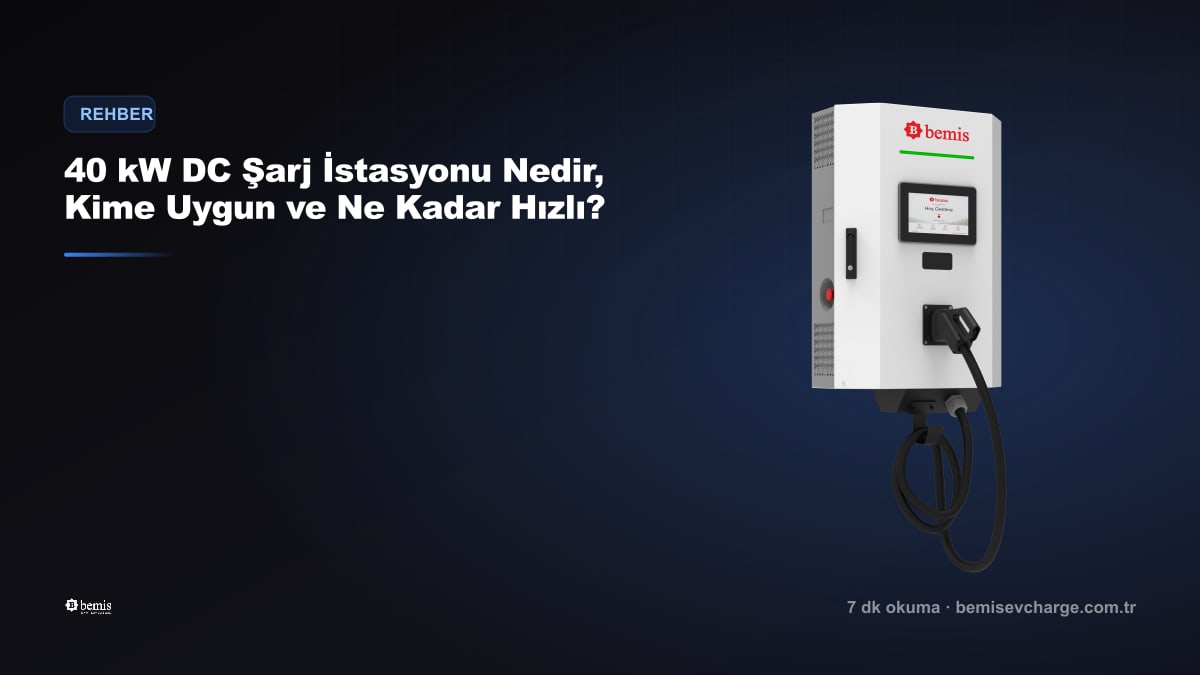
What Is a 40 kW DC Charging Station, Who Is It For and How Fast Is It?
Someone searching for a "40 kW DC charging station" usually wants to know two things: how quickly does this station fill a car, and is it right for my business (a shopping centre, hotel, supermarket, office building or small vehicle fleet)? In this guide we explain in plain language why DC fast charging is faster than AC, what 40 kW really means with a worked example, which locations it suits and where the 40 kW option sits in the Bemis BEVDC series. Instead of promising exact minutes and prices, we focus on the real technical facts that will put your decision on the right footing.
What is DC fast charging and why is it faster than AC?
The easiest way to understand the difference is to look at "where the electricity is converted". The electricity coming from the grid is alternating current (AC), while the battery is filled with direct current (DC). In AC charging this AC→DC conversion is done by the converter inside the vehicle (the onboard charger), and that unit is usually limited to 7.4-22 kW — so however powerful the station is, the car's own unit sets the ceiling. In DC charging the conversion is done INSIDE the station and DC is fed straight to the battery. The limit of the onboard unit is thus taken out of the equation; charging at much higher power, and much faster, becomes possible. That is exactly why "fast charging" is possible.
- AC charging: the conversion is done in the vehicle; the speed is limited by the converter inside the car (mostly 7.4-22 kW).
- DC charging: the conversion is done inside the station; DC is fed straight to the battery and the ceiling of the onboard unit is bypassed.
- The result: a DC station transfers far more energy in the same time — which is why it is called "fast charging".
- In Türkiye the standard connector for public DC charging is CCS2.
How fast is a 40 kW DC charging station?
For a rough estimate there is a simple formula: time ≈ energy to be added to the battery (kWh) ÷ charging power (kW). An example (hypothetical): suppose you want to add 40 kWh to your battery. On a car that accepts the full 40 kW this theoretically takes about 1 hour (40 ÷ 40 = 1). Taking the same 40 kWh at 22 kW AC comes to about 2 hours; and since the converter inside many cars accepts 11 rather than 22 kW, the time on AC can stretch even further. The real time depends on the power the car accepts at that moment and on the battery deliberately slowing down (especially past 80%), that is, on taper. That is why a firm promise of "full in X minutes" is not realistic — the formula only gives you the right order of magnitude.
Who is 40 kW DC for? Where is it used?
40 kW is a cost-effective entry point into the DC world: distinctly faster than AC, but at a more suitable scale than the very high-power units found on motorways. It is tailor-made for medium-intensity locations where a customer or an employee parks the car and gets a worthwhile amount of charge while going about something else (shopping, a meal, a meeting, an overnight stay).
- Shopping centres and supermarkets: the car charges while the customer shops.
- Hotels, office buildings and restaurants: the length of a stay or a visit allows enough time for charging.
- Business and office car parks: a practical speed for staff and visitor vehicles.
- Small vehicle fleets: top-ups during the day keep the vehicle out in the field.
By contrast, at motorway service areas, at locations with very high vehicle turnover or where the expectation is "fill it in the shortest possible time without a break", 40 kW may fall short; at such places higher-power DC units in the 80-200 kW range are preferred. The right power is chosen less by the brand of the device than by the traffic of the location and the waiting time that is acceptable there.
AC 22 kW, DC 40 kW or DC 80-120 kW? A decision table
| Option | Typical speed | Where it suits | Who it suits |
|---|---|---|---|
| AC 22 kW (wallbox) | The slowest; limited by the onboard unit | Home, workplace, places where cars are parked for a long time | End users who park overnight or all day |
| DC 40 kW | Medium-fast; distinctly faster than AC | Shopping centre, hotel, supermarket, office building, restaurant, office | Businesses that want cost-effective DC |
| DC 80-120 kW | High; a serious top-up during a short break | Motorways, busy public locations | Investors who want fast turnover and high circulation |
The key question when reading the table is this: how long does the person parking the car stay there? If the stay is long and the aim is "let it fill overnight", AC 22 kW is enough. If the stay is a few hours (shopping, a meal, an overnight stay) and you want to offer the customer a concrete amount of charge, 40 kW DC fills exactly that gap. If the stay is very short and the aim is "back on the road as fast as possible", 80 kW and above is needed. That is why many businesses prefer to start with 40 kW DC before enlarging the investment and to scale up as they see real demand.
The Bemis BEVDC series: 40, 80, 120, 160 and 200 kW
Bemis's DC fast-charging family is the BEVDC series, offering options from 40 kW up to 200 kW. The whole series has CCS2 connectors, is compatible with the OCPP 1.6J / 2.0.1 protocols (remote management, user authorisation and reporting), takes an AC 380-480 V three-phase input, delivers a 150-1000 V DC output and has an enclosure protected for outdoor use. The BEVDC 40, the 40 kW entry point, has a single socket; that is, it charges one car at a time and is ideal for single-point scenarios.
| Model | Output power | Sockets | Simultaneous charging | Connector | OCPP |
|---|---|---|---|---|---|
| BEVDC 40 | 40 kW | 1 | No | CCS2 | 1.6J / 2.0.1 |
| BEVDC 80 | 80 kW | 2 | Yes | CCS2 | 1.6J / 2.0.1 |
| BEVDC 120 | 120 kW | 1 or 2 | Yes | CCS2 | 1.6J / 2.0.1 |
| BEVDC 160 | 160 kW | 2 | Yes | CCS2 | 1.6J / 2.0.1 |
| BEVDC 180 | 180 kW | 2 | Yes | CCS2 | 1.6J / 2.0.1 |
| BEVDC 200 | 200 kW | 2 | Yes | CCS2 | 1.6J / 2.0.1 |
The single-socket BEVDC 40 is the way to move up to DC speed with a low entry cost, for small businesses and single-point installations. As the need grows — more cars, higher circulation — the dual-socket models of 80 kW and above, capable of simultaneous charging, come into play. This makes it possible to start with 40 kW today and plan towards higher power tomorrow.
OCPP compatibility also matters from the operator's point of view: thanks to remote monitoring, user authorisation and reporting, the station can be connected to a management platform, usage can be tracked and different pricing scenarios can be set up. In public or fleet use, this feature turns the station from just a device into a manageable service point — and makes the operational side of the investment easier too.
What is needed to install a 40 kW DC station?
DC fast charging requires a stronger electrical infrastructure than an AC wallbox. The general requirement is a three-phase supply of sufficient power (the BEVDC series takes an AC 380-480 V three-phase input) and installation by a qualified team. The exact electrical values — your facility's existing connection capacity, the board and cable cross-sections, the protective equipment needed and any requirement to increase capacity — must always be assessed on site by an expert. Correct sizing is essential both for safety and for the station to run without trouble.
Looking for the right DC power for your business? See the Bemis BEVDC fast-charging units, from 40 kW up to 200 kW.
See the DC fast-charging unitsFrequently Asked Questions
How long does a 40 kW DC charging station take to fill a car?
It would not be right to give an exact number of minutes, because the time depends on your car. The formula for a rough estimate is: time ≈ energy to be added (kWh) ÷ charging power (kW). For example, on a car that accepts the full 40 kW, 40 kWh is added in about 1 hour. However, not every car accepts 40 kW, and once the battery passes 80% the charging speed slows deliberately (taper). The real time therefore varies with the car's acceptance rate and its state of charge; the formula only gives the right order of magnitude, not a firm promise.
Why is 40 kW DC charging faster than AC at 22 kW?
Because the place where the energy is converted differs between AC and DC charging. In AC charging the converter that turns the grid's alternating current into the battery's direct current is inside the vehicle and is usually limited to 7.4-22 kW; even a more powerful station cannot exceed that ceiling. In DC charging the conversion happens inside the station and DC is fed straight to the battery, so the limit of the onboard unit is taken out of the equation. As a result a 40 kW DC station transfers distinctly more energy in the same time than 22 kW AC and fills the car in less time.
Which businesses is a 40 kW DC charging station suitable for?
40 kW is a cost-effective DC option for medium-intensity locations. It is ideal for shopping centres and supermarkets, hotels, office buildings and restaurants, office and business car parks and small vehicle fleets, because the customer or member of staff parks the car and gets a worthwhile amount of charge while going about their business. At motorway service areas, at locations with very high vehicle turnover or where charging in the shortest possible time is expected, higher-power DC units in the 80-200 kW range are more suitable. The right power is chosen according to the traffic of the location.
How many sockets does the Bemis BEVDC 40 have and which cars does it work with?
The BEVDC 40 has an output of 40 kW and a single socket; that is, it charges one car at a time and is designed for single-point scenarios. It uses the CCS2 connector, which is the standard connector for public DC charging in Türkiye. It is compatible with the OCPP 1.6J / 2.0.1 protocols (remote management, authorisation and reporting), takes an AC 380-480 V three-phase input, delivers a 150-1000 V DC output and has an enclosure protected for outdoor use. When more cars or higher power are needed, the dual-socket BEVDC models of 80 kW and above are the choice.
What kind of infrastructure is needed to install a 40 kW DC charging station?
DC fast charging requires a stronger electrical infrastructure than an AC wallbox. In general a three-phase supply of sufficient power is needed; the Bemis BEVDC series runs on an AC 380-480 V three-phase input. The installation must always be carried out by a qualified team. Exact electrical values — your existing connection capacity, the board and cable cross-sections, the protective equipment and, if necessary, an increase in capacity — must be assessed on site by an expert. Correct sizing is critical both for safety and for the station to run without interruption.