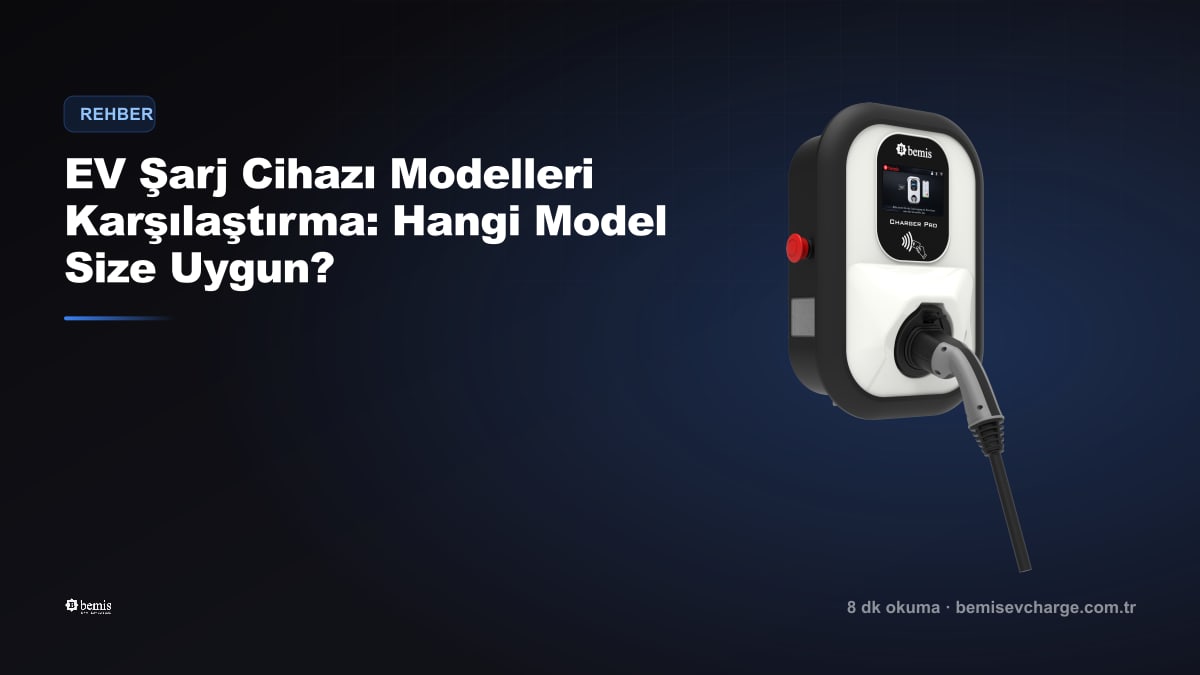
EV Charger Models Compared: Which One Is Right for You?
The question most people ask when choosing an electric vehicle charger is: with so many models out there, which one is right for me? The honest answer isn't a single model — it's hidden in your usage scenario. Will you charge at home, at work or at a public point? Is your electrical supply single-phase or three-phase? Is speed your priority, or portability? In this guide we compare AC wallbox, DC fast charging and portable models using their real technical figures, and explain exactly which to choose in each situation with clear tables.
First decision: AC, DC or portable?
Before picking a model, you need to settle on the charging type. There are three main groups, and for most people the choice becomes clear quickly:
- AC Wallbox (wall-mounted): the standard solution for homes, apartment blocks and workplaces. It charges at 3.7–22 kW through the car's own onboard charger and is ideal for overnight or all-day charging.
- DC Fast Charging: for public points, motorways, shopping centres and fleets. It fills the car far faster at 40 kW and above, but requires high-power three-phase infrastructure and isn't installed at home.
- Portable Charger: a flexible, plug-in solution you carry with you — suitable as a second/backup charger or for anyone who can't fit a fixed unit.
AC wallbox models compared
The Bemis AC wallbox range is fully Type 2 (IEC 62196-2) and goes up to 22 kW on three-phase infrastructure. The range extends from an entry-level model up to a smart/connected model, and every model is available with a fixed 5-metre cable or a panel-socket output.
| Model | Power | Phase | Max. Current | Connector | Smart / OCPP |
|---|---|---|---|---|---|
| Charger 2 | 11 – 22 kW | Three-phase | 16 – 32A | Type 2 | – |
| Charger Plus 2 | 3,7 – 22 kW (adjustable) | Three-phase | 6 – 32A | Type 2 | – |
| Charger Pro 2 | 3,7 – 22 kW (adjustable) | Three-phase | 6 – 32A | Type 2 | – |
| Charger Pro 2 GSM | 3,7 – 22 kW (adjustable) | Three-phase | 6 – 32A | Type 2 | GSM + OCPP 1.6 |
Charger 2 is the entry level; its power is adjustable between 3.7 – 22 kW (you can dial it down to your installation's limit). Charger Plus 2 and Charger Pro 2 add OCPP 1.6 and an optional MID meter to the same power range. Charger Pro 2 GSM, with its GSM module and OCPP 1.6 protocol, is built for workplace and fleet scenarios that need remote management, user authorisation and reporting.
DC fast charging models compared
The Bemis DC range (BEVDC) is designed for public and fleet use; every unit takes an AC 380–480V 3-phase input, delivers a 150–1000V DC output through a CCS2 connector and is OCPP 1.6J / 2.0.1 compatible. Power and the number of sockets are chosen to suit the need:
| Model | Output Power | Number of Sockets | Simultaneous Charging | Connector | OCPP |
|---|---|---|---|---|---|
| BEVDC 40 | 40 kW | 1 | Hayır | CCS2 | 1.6J / 2.0.1 |
| BEVDC 80 | 80 kW | 2 | Evet | CCS2 | 1.6J / 2.0.1 |
| BEVDC 120 | 120 kW | 1 veya 2 | Evet | CCS2 | 1.6J / 2.0.1 |
| BEVDC 160 | 160 kW | 2 | Evet | CCS2 | 1.6J / 2.0.1 |
| BEVDC 180 | 180 kW | 2 | Evet | CCS2 | 1.6J / 2.0.1 |
| BEVDC 200 | 200 kW | 2 | Evet | CCS2 | 1.6J / 2.0.1 |
The single-socket, lower-power models (BEVDC 40) suit small businesses and single-point scenarios; the dual-socket, higher-power models capable of simultaneous charging (80 kW and above) are suited to busy stations and motorway locations.
Portable charger models
The portable range consists of flexible, plug-in solutions that come with their own carry case and need no fixed installation. There are three tiers to match your power needs and your electrical supply (single-phase/three-phase):
| Model | Power | Phase | Max. Current | Cable |
|---|---|---|---|---|
| Mini Mobile | 2.3 – 3.7 kW | Single-phase | 16A | 5 m |
| Mono Mobile | 3.7 – 7.4 kW | Single-phase | 32A | 5 m |
| Pro Mobile | 11 – 22 kW | Three-phase | 32A | 5 m |
Mini Mobile is the most compact option for a household socket and emergency/backup use. Mono Mobile delivers higher power on a single-phase supply and comes with socket adapters. Pro Mobile goes up to 22 kW on a three-phase supply — it's for those who want power close to a wallbox despite the portability.
Fixed cable or panel socket?
The second decision you'll often face with AC models is the output type. On a cable model, the 5-metre Type 2 cable is fixed to the unit — you just plug in and charge, which is practical. On a panel-socket model, the unit has a Type 2 socket and you plug in your own cable; this suits users who run more than one car/cable or prefer to store the cable separately. Both deliver the same power; the difference comes down to how you like to use it.
Which model for which scenario?
- Home / apartment (single car, overnight charging): AC Wallbox Charger 2, or the adjustable-power Charger Plus 2 — 7–11 kW is more than enough overnight for most cars.
- Workplace / fleet (authorisation, reporting, payment): Charger Pro 2 GSM — remote management and per-user reporting via OCPP 1.6.
- Public / motorway / shopping centre (speed matters): the DC range — BEVDC 40 (single point) or a dual-socket 80–200 kW unit, depending on traffic.
- Travel / backup / where installation isn't possible: the portable range — Mini/Mono Mobile for single-phase, Pro Mobile for three-phase power.
Explore every Bemis EV charging model with its technical specs — all locally manufactured.
Explore ProductsWhichever model you choose, Bemis E-V Charge products are manufactured locally at the company's integrated facilities in Bursa; the software and PCB design belong to Bemis. To choose the right model, remember to factor in your car's onboard charging power and the capacity of your electrical installation — and if you're not sure, we can work it out together at the quotation stage.
Frequently Asked Questions
How many kW of charger is enough for a home?
For most home users, an AC wallbox in the 7–11 kW range is more than enough. While your car sits parked overnight for 8–10 hours, even 7.4 kW fully charges most batteries. Higher power (22 kW) only makes sense if you have a three-phase installation and your car's onboard charger accepts that power; otherwise the car itself is the limit. Because Bemis Charger Plus and Pro models let you adjust the power between 3,7 – 22 kW, you can pick the value that suits your installation and use it with confidence. When deciding, weigh up both your fuse/line capacity and your car's acceptance power together.
Should I buy a cable model or a panel-socket model?
Both deliver the same power; the difference comes down to how you like to use it. On a cable model, the 5-metre Type 2 cable is fixed to the unit — you arrive home, plug in and charge, which is the most practical method and ideal for most single-car home use. On a panel-socket model, the unit has a Type 2 socket and you plug in your own cable; this suits users who run more than one car, prefer to keep the cable in the boot, or want to store it separately. Panel-socket models can also be preferable at workplaces where different users bring their own cables.
Can a DC fast charger be installed at home?
In practice, no. DC fast chargers (the BEVDC range) operate at 40 kW and above, require a high-power AC 380–480V three-phase input, and are designed for public points, motorways, shopping centres and fleet depots. A home's standard electrical infrastructure can't supply this power, and an investment on this scale is unnecessary for home use. The right solution for home charging is an AC wallbox — at 7–11 kW it charges your car quietly and safely overnight. DC fast charging is positioned at public stations to meet the need for a quick top-up during a short stop on a long journey.
When is smart charging (OCPP) necessary?
OCPP (Open Charge Point Protocol) is an open standard that connects a charger to a management system, and it's generally needed in workplace, residential-complex and fleet scenarios. If you want to authorise users (via RFID/app), report the energy each user consumes, apply billing, or centrally monitor several units, an OCPP-compatible model is essential. The Bemis Charger Pro 2 GSM model meets these needs with its GSM module and OCPP 1.6 protocol. For single-car home use, OCPP isn't required; a simple wallbox is enough. If your needs are likely to grow, choosing an OCPP-compatible model from the outset makes the transition easier.
Does a portable charger replace a fixed wallbox?
Partly — it depends on the need. A portable charger (Mini/Mono/Pro Mobile) is a flexible solution you plug in and carry with you; it's ideal for users who can't fit a fixed unit, are renting, or want a second/backup charger. Pro Mobile comes close to a wallbox in power terms, reaching up to 22 kW on a three-phase installation. That said, a fixed wallbox — with its dedicated line, permanent mounting and generally more settled cable management — is more comfortable and durable for everyday home charging. If you'll charge regularly at one point, a wallbox makes sense; for mobile/flexible use, a portable charger does; and many users run both together.