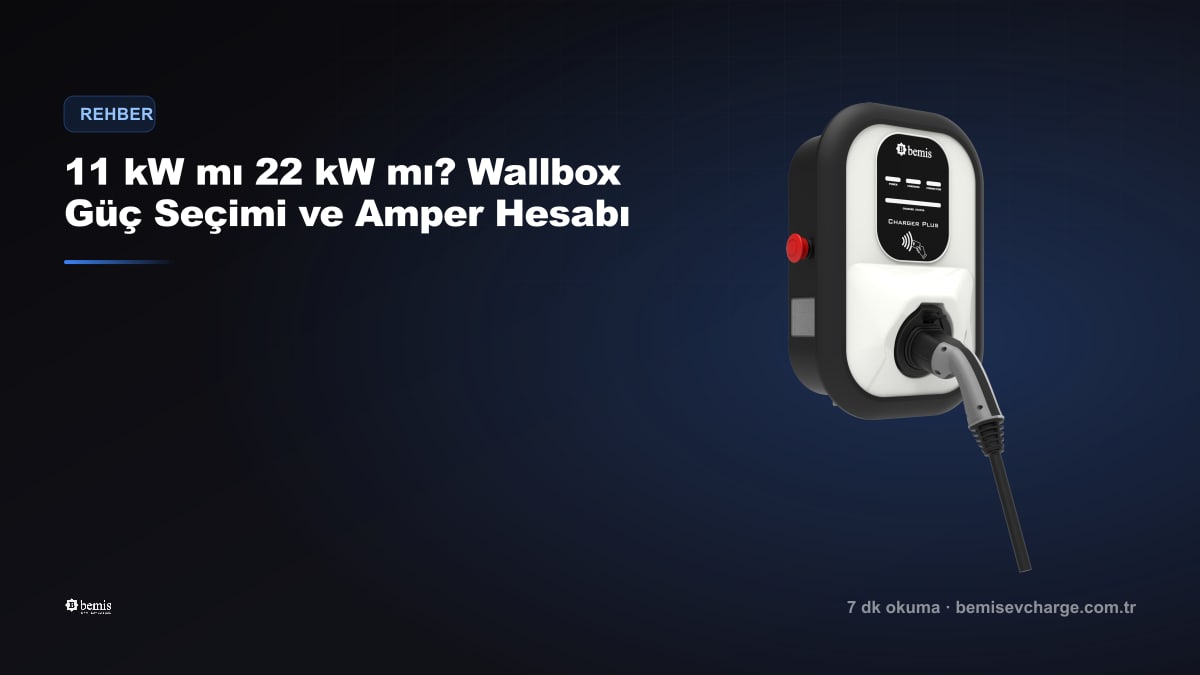
11 kW or 22 kW? Wallbox Power Selection and Amperage Calculation
Short answer: for a single car that charges every night in its own parking space, 11 kW is more than enough; 22 kW makes sense if your vehicle accepts 22 kW AC and you need fast top-ups during the day or charge several cars one after another. If your car accepts 11 kW, buying a 22 kW device brings no extra speed; it only pays off when you change cars later. That is why the decision has two steps: first the car, then the installation.
Step 1 — The car first: AC charging acceptance rate
The wallbox supplies energy to the charger inside the vehicle (the onboard charger); it is this unit that determines how fast the energy enters the battery. Look for the "AC charging power" or "onboard charger" line in the vehicle's specifications:
- 7.4 kW (single-phase onboard charger): even connected to a three-phase device, the car draws 7.4 kW.
- 11 kW (three-phase 16 A): the great majority of electric cars sold today belong to this class.
- 22 kW (three-phase 32 A): only a few models offer it as standard or as an option.
The vehicle's acceptance rate is the ceiling; the device cannot go above it. Devices with adjustable power (Charger Plus 2, Charger Pro 2) adapt automatically to the current the car accepts thanks to their smart charging algorithm.
Step 2 — Then the installation: single-phase or three-phase?
On a single-phase installation (one phase, 230 V) the highest practical power is 7.4 kW at 32 A; 11 and 22 kW require a three-phase line (three phases, 400 V). In Türkiye most detached houses and new buildings have a three-phase connection; older flats may be single-phase. The meter and the main breaker in your distribution board show this; if you are not sure, the site survey will clarify it.
| Power | Phase | Current | Breaker (typical) | 60 kWh charge time |
|---|---|---|---|---|
| 3.7 kW | Single-phase | 16 A | 1×16 A | ~17–19 hours |
| 7.4 kW | Single-phase | 32 A | 1×32 A | ~8–9 hours |
| 11 kW | Three-phase | 3×16 A | 3×16 A | ~5.5–6.5 hours |
| 22 kW | Three-phase | 3×32 A | 3×32 A | ~2.7–3.3 hours |
How many amps is 22 kW? The formula
On a single phase, power = voltage × current: 230 V × 32 A ≈ 7.4 kW, 230 V × 16 A ≈ 3.7 kW. On three phases, power = √3 × voltage × current: 1.73 × 400 V × 32 A ≈ 22 kW, 1.73 × 400 V × 16 A ≈ 11 kW. So the answer to how many amps 22 kW is comes to 32 A per phase, and for 11 kW it is 16 A per phase. The other way round: how many kW is 32 A? 7.4 kW single-phase, 22 kW three-phase; how many kW is 16 A? 3.7 kW single-phase, 11 kW three-phase.
Cable cross-section and residual current protection
Typical values: 5×6 mm² for 3×32 A (22 kW) over a short distance, 5×2.5 mm² for 3×16 A (11 kW) and 3×6 mm² copper cable for single-phase 32 A (7.4 kW). As the distance grows the cross-section increases in order to limit the voltage drop; that is why the final cross-section is set by the qualified electrician according to the distance from the board to the device. Residual current protection is mandatory in every installation: protection that detects the DC residual component (a Type A RCD together with the 6 mA DC detection inside the device, or a Type B RCD) is planned by the electrical contractor.
How is charging time calculated?
Time (hours) ≈ energy to be charged (kWh) ÷ charging power (kW), plus 10–20% losses. A driver covering 40 km a day uses roughly 7–9 kWh; an 11 kW device replaces that in less than 1 hour, a 7.4 kW device in 1–1.5 hours. For a car parked for 8 hours overnight there is no power race; the difference appears when a lot of energy is needed in a short time during the day.
When does adjustable power make sense?
In three situations: if your installation is limited today (for example a 3×25 A main breaker), you can cap the device at 11 kW and open it up later; if your car accepts 7.4 kW but your next car will accept 11 kW; if you need dynamic load balancing because of the other loads in the house. All second-generation Bemis devices are adjustable between 3.7 and 22 kW (6–32 A); the Charger 2 is the entry level, while the Charger Plus 2 and Charger Pro 2 additionally offer OCPP 1.6 and metering options.
Decision table
| Situation | Recommendation |
|---|---|
| One car, every night in its own parking space | 11 kW (7.4 kW is enough if the car accepts 7.4 kW) |
| Single-phase installation, no upgrade planned | 7.4 kW single-phase wallbox |
| Two cars, or frequent short top-ups during the day | 22 kW (if the car accepts it) or two 11 kW units with load sharing |
| Workplace, residential complex, fleet | 22 kW adjustable + dynamic load management + OCPP |
| Installation and future car uncertain | Adjustable power (Charger Plus 2 / Pro 2) |
Bemis home charging stations: 3.7 – 22 kW adjustable power, tethered or with a socket.
Compare the modelsFrequently Asked Questions
How many amps is 22 kW?
32 A per phase on a three-phase 400 V line. The formula: 1.73 × 400 V × 32 A ≈ 22 kW. 11 kW requires 16 A per phase.
How many amps does the breaker need for 11 kW?
A 3×16 A three-phase breaker on a dedicated line. For 22 kW it is 3×32 A, for 7.4 kW a single-phase 1×32 A. Residual current protection is mandatory in every case; the cable cross-section is determined by the distance.
Is an 11 kW wallbox possible on a single-phase installation?
No. On a single phase the practical upper limit is 7.4 kW at 32 A. 11 and 22 kW require a three-phase connection and line.
If my car accepts 11 kW, will a 22 kW device damage it?
No. The wallbox supplies the current the car asks for; the car draws 11 kW. A 22 kW device is only an advantage if you later buy a car that accepts 22 kW.
Does dynamic load balancing make a breaker upgrade unnecessary?
In most homes, yes. The device lowers the charging power when the total consumption of the house approaches the main breaker limit, and raises it again when the air conditioner or the oven switches off. This makes safe charging possible without increasing your connection capacity.