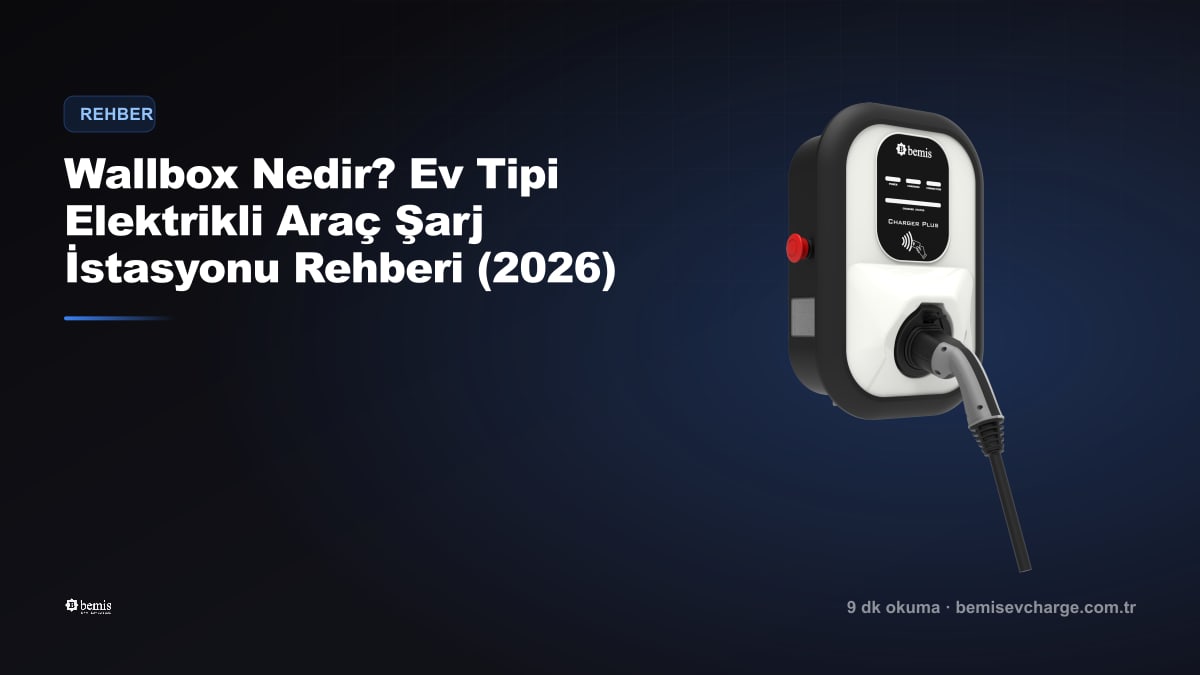
What Is a Wallbox? Home EV Charging Station Guide (2026)
A wallbox is the AC charging device mounted on the wall to charge your electric car safely from the grid at home, in an apartment car park or at work. In Türkiye the same product is called a home charging station, a wall-mounted charger, a fixed charging unit and a wallbox; all mean the same thing. What sets it apart from an ordinary household socket is that it can deliver 7.4–22 kW over its own dedicated line and protection circuits, and that it manages the session by communicating with your car.
This guide answers, one by one, the first five questions a home user considering a wallbox asks: Why is it better than a socket? AC or DC? Fixed or portable? Which power level? Tethered or socketed? At the end you will find the installation steps, the items that drive the price and a comparison of the Bemis home charging station models.
What is a wallbox and what does it do?
An electric car's battery is charged with direct current (DC), while the grid at home supplies alternating current (AC). The charger inside the vehicle (the onboard charger) performs this conversion. The wallbox's job is not to fill the battery directly but to supply safe, controlled AC energy to the vehicle's charging unit. That is why home charging stations are called AC chargers.
- Communication: the wallbox tells the car how many amps it may draw using the IEC 61851 protocol, and the car draws only what it accepts. When the cable is plugged in but no car is connected, the connector carries no voltage.
- Protection: charging is cut off when residual current, overcurrent, overheating or an earthing fault is detected.
- Management: authorisation with an RFID card, scheduling according to the night tariff, remote on/off from the app, consumption history.
- Durability: the IP65 enclosure is fully dust-tight and withstands water jets from any direction; no extra cabinet is needed in an open car park.
How it differs from an ordinary socket: why a wallbox?
A household socket delivers at most 2.3 kW at 10 A and is not designed to run at full load for hours; it carries a risk of overheating and loose contact. A portable charger plugs into a socket, has its own protection circuit and can deliver 3.7–7.4 kW (up to 22 kW on a three-phase socket); it is a good middle ground for those who do not want a fixed installation. A wallbox, on the other hand, is permanently connected to a dedicated line run from the distribution board and is designed for unattended charging at the same speed every night.
| Household socket | Portable charger | Wallbox | |
|---|---|---|---|
| Power | 2.3 kW | 3.7 – 7.4 kW (up to 22 kW on a three-phase socket) | 7.4 – 22 kW |
| Charging time from empty | ~26 hours | ~8 – 16 hours | ~2.7 – 8 hours |
| Protection | The socket itself | Residual current / thermal protection inside the device | Device + dedicated line, breaker and residual current device |
| Use | Emergency | Travel, rented home, temporary solution | Regular charging every night, shared car park, workplace |
AC or DC? Why AC at home?
DC fast-charging stations (40 kW and above) perform the conversion inside the unit and fill the battery directly; they are designed for main roads and public locations and require a transformer and high-power infrastructure. At home your car is parked for 10–12 hours on average; in that time 11 kW AC charging takes a 60 kWh battery from empty to full. There is no need for a DC charger at home; for the details, see the guide on the difference between AC and DC charging.
Fixed wallbox or mobile (portable) wallbox?
A fixed wallbox is mounted on the wall and connected to its own line run from the distribution board. A portable charger — also called a mobile wallbox — plugs into a CEE (three-phase) or household socket and travels in its case. The decision depends on how you use it:
- If you have your own garage or a fixed parking space and will charge every night: a fixed wallbox. Higher continuous power, lower contact risk, smart management.
- If you rent, if your parking space changes or if you move between a summer and a winter address: a portable device (the Bemis Mini, Mono and Pro Mobile series).
- If you are undecided: starting with a portable device and having a wallbox installed once the permanent address is settled is a common route; both devices use the Type 2 standard.
Which power: 7.4 / 11 / 22 kW
In choosing power the car comes first and the installation second. Most electric cars accept 11 kW on the AC side; some models are limited to 7.4 kW, and few accept 22 kW. If your car accepts 11 kW, a 22 kW device adds no speed. On the installation side, 7.4 kW works on a single-phase line, while 11 and 22 kW need a three-phase line.
| Power | Phase | Current | Breaker | 60 kWh charging time |
|---|---|---|---|---|
| 7.4 kW | Single-phase | 32 A | 1×32 A | ~8–9 hours |
| 11 kW | Three-phase | 3×16 A | 3×16 A | ~5.5–6.5 hours |
| 22 kW | Three-phase | 3×32 A | 3×32 A | ~2.7–3.3 hours |
If your installation can take 11 kW today but you are considering going up to 22 kW later, a device whose power is adjustable between 3.7 and 22 kW (Charger Plus 2, Charger Pro 2) lets you grow without replacing the device. For the detailed amperage and breaker calculation, see the guide 11 kW or 22 kW.
Tethered or socketed (with an outlet)?
On the tethered model a 5 metre Type 2 cable is fixed to the device: you park the car, plug in the cable, done. For a home user charging the same car every day, this is the most practical option. On the socketed model the device has a Type 2 outlet and you use your own cable; it is preferred for several cars, guest charging, residential complexes and workplace car parks. Power and protection are identical in both types; the only difference is how you use them.
Smart features: which ones do you really need?
- RFID card: makes sure only authorised people can use the device in a shared car park. It is not essential in your own garage, but it is a free layer of security.
- App and scheduling: setting charging to start when the night tariff begins, and seeing the consumption history. This is the feature that directly lowers the electricity bill.
- Dynamic load balancing: automatically reduces the charging power when the air conditioner, oven or heat pump switches on, preventing the breaker from tripping. In homes with a limited main breaker it takes the place of an expensive breaker upgrade.
- OCPP 1.6: connects the device to a management system or an operator platform; it is needed for reporting and billing in residential complexes, workplaces and fleet installations. It is not needed in a single-car home.
- GSM (4G) module: provides connectivity in car parks with no Wi-Fi or wired internet.
- MID meter: records consumption to legal metering accuracy; it is needed for shared use in apartment buildings and complexes, and for tenant and fleet billing.
Installation step by step
- 1. Site survey: the authorised dealer or electrician examines the distribution board, the main breaker, the phase configuration and the position of the device, and measures the cable run.
- 2. Line and protection: a dedicated line is run from the main board to the device; a breaker and residual current protection matched to the power are fitted. The cable cross-section is set according to the distance.
- 3. Installation: the device is fixed to the wall; the IP65 enclosure needs no extra cabinet outdoors. On the tethered model the cable holder is planned, on the socketed model the orientation of the outlet.
- 4. Commissioning: phase sequence, earthing and residual current tests are carried out; Wi-Fi/app pairing is done and RFID cards are registered.
- 5. Test charge: the car is connected and it is confirmed that the power is at the expected level and that charging continues without interruption.
In apartment buildings and residential complexes, the approval of the building management and a metering plan are added to these: whether the supply comes from your own meter or the shared meter, and whether a model with a MID meter is needed for shared use. For the charging infrastructure requirement per parking space in new buildings, see the guide on the charging station regulation.
What determines the price of a wallbox?
Four items determine the price of the device: power (7.4 / 11 / 22 kW), output type (tethered / socketed), smart options (OCPP, GSM, MID meter) and the warranty and service scope. Installation is a separate item and is not included in the device price; the distance from the board to the device, the cable cross-section, the breaker and the work on the board are clarified during the site survey. What usually affects the total budget most is not the device but a long cable run and a board upgrade; so do not decide before having a site survey.
Bemis home charging station models
| Series | Power | Highlights | Best suited to |
|---|---|---|---|
| Charger 2 | 7.4 kW single-phase · 11 / 22 kW three-phase (fixed) | RFID, display, Wi-Fi, scheduling from the app | Single-car home, entry level |
| Charger Plus 2 | 3.7 – 22 kW adjustable | Smart charging algorithm, automatic resume after an interruption, OCPP 1.6, optional MID | Home, small business, anyone planning a power increase later |
| Charger Pro 2 | 3.7 – 22 kW adjustable | Advanced load management (DLM), user authorisation, OCPP 1.6, optional MID | Residential complex, workplace, operator |
| Charger Pro 2 GSM / MID | 3.7 – 22 kW adjustable | 4G module, integrated certified MID meter | Car parks without internet, shared-use billing, fleets |
A comparison of all 19 models by power, output type, GSM, MID and OCPP is on the category page.
See the home charging station modelsShort decision guide: fixed parking space + charging every night = wallbox; if your car accepts 11 kW then 11 kW is enough; tethered for a single car in your own garage, socketed for a shared car park; do not set a budget before having a site survey.
Frequently Asked Questions
What is a wallbox?
A wallbox is the AC charging device mounted on the wall to charge an electric car safely from the grid at home or at work. Home charging station and wall-mounted charger describe the same product. It delivers 7.4–22 kW over its own line and protection circuits and communicates with your car using the IEC 61851 protocol.
What is the difference between a wallbox and a household socket?
A household socket delivers at most 2.3 kW and is not designed to run at full load for hours. A wallbox delivers 7.4–22 kW over a dedicated line, provides residual current and overcurrent protection and manages the session according to the current the car accepts; it is 3–10 times faster and safer.
Do I need AC or DC charging at home?
AC. At home the car is parked for 10–12 hours on average; in that time 11 kW AC charging fills a 60 kWh battery. DC fast chargers deliver 40 kW and above and are public solutions that require heavy infrastructure.
Should I buy a fixed wallbox or a portable charger?
A fixed wallbox if you have your own garage and a fixed parking space; a portable device if you rent, if your parking space changes or if you move between two addresses. Both use the Type 2 standard.
What is needed to install a wallbox?
A site survey by a qualified electrician or dealer, a dedicated line from the main board, a breaker and residual current protection matched to the power, installation and a commissioning test. In an apartment building the approval of the building management and a metering plan are also required. Installation is not included in the device price.
What determines the price of a wallbox?
Power (7.4 / 11 / 22 kW), output type (tethered / socketed), smart options (OCPP, GSM, MID meter) and the installation work (cable run length, cable cross-section, work on the board). A long cable run and a board upgrade affect the budget most; the site survey makes it clear.
Related