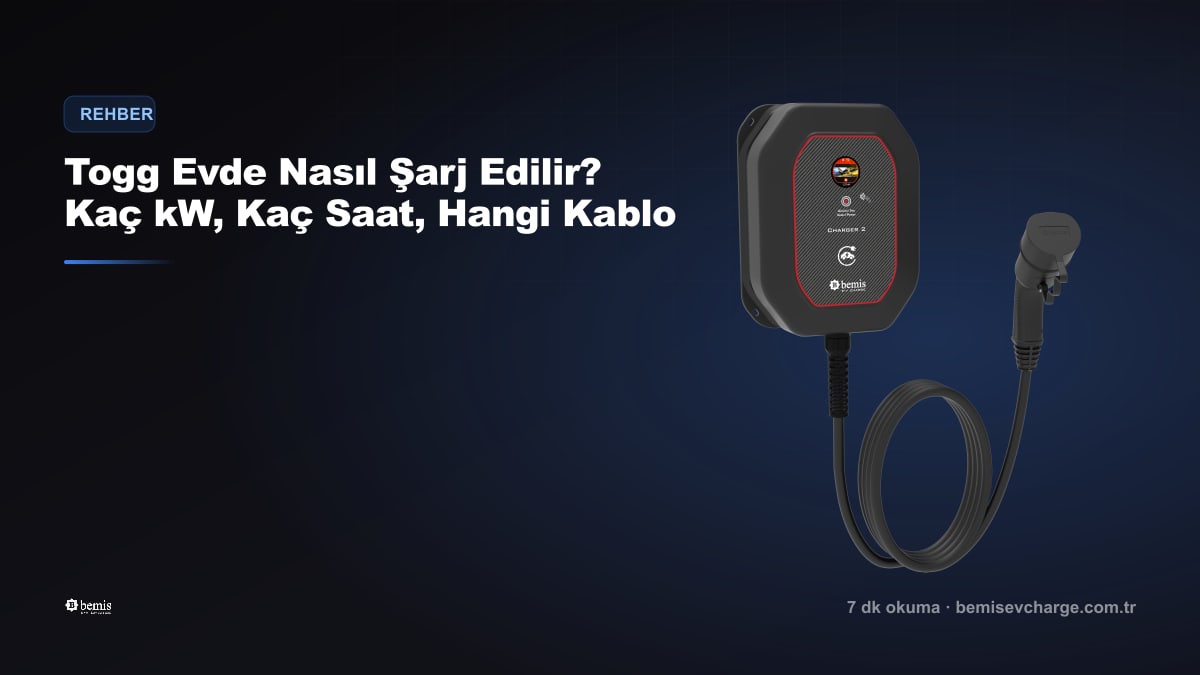
How to Charge a Togg at Home: How Many kW, How Many Hours, Which Cable
The first question after buying a Togg is usually this: how do I charge it at home and how long will it take? The answer is not a single number but the intersection of three things: the car's onboard AC charger, your home's wiring (single phase or three phase) and the device you use. This guide goes through all three in order.
Can a Togg be charged at home?
Yes. For AC charging Togg uses the Type 2 socket, the standard in Türkiye and Europe, so you do not need to look for a special socket type to charge at home. There are three ways to do it at home: an ordinary domestic socket (slowest, a temporary solution), a portable charger plugged into a socket or a charging set with Type 2 on both ends, and a wall-mounted home charging station. The difference between them is speed and permanence.
How many kW does a Togg charge at? This is what really decides it
In AC charging the speed is set not by the device but by the onboard charger inside the car. Even if you buy a 22 kW device, a car whose onboard unit is 11 kW will draw 11 kW. On the Togg side this value depends on the model and the production period:
| Model / production period | Onboard AC charger | Practical ceiling on three-phase wiring |
|---|---|---|
| Togg T10F (from first production) | 11 kW | 11 kW |
| Togg T10X · 2023 – 15 June 2026 | 22 kW | 22 kW |
| Togg T10X · after 15 June 2026 | 11 kW | 11 kW |
Because this distinction depends on the production batch, do not treat 22 kW as the default: in current production the standard value is 11 kW. Check which one your own car has from the registration document and equipment list, or through an authorized service — a wrong assumption leads you to install unnecessarily powerful (and expensive) wiring at home.
How long does a Togg take to charge at home?
The times below are for taking the battery from 10% to 100% and they include conversion losses. The battery figures belong to the two Togg versions: Standard Range 50 kWh and Long Range 85 kWh. The calculation uses exactly the same method as the charging time calculator on this site.
| Power at home | 50 kWh · Standard Range | 85 kWh · Long Range |
|---|---|---|
| Ordinary domestic socket (about 2,3 kW) | 21 h 44 min | 36 h 57 min |
| 3,7 kW · 16A single phase | 13 h 31 min | 22 h 58 min |
| 7,4 kW · 32A single phase | 6 h 45 min | 11 h 29 min |
| 11 kW · 16A three phase | 4 h 33 min | 7 h 44 min |
| 22 kW · 32A three phase | 2 h 16 min | 3 h 52 min |
The last row applies ONLY to a T10X whose onboard charger is 22 kW. If your car draws 11 kW you will get the time in the 11 kW row even on a 22 kW device. Also, taking the battery from 10% to 100% is rare in daily use; in typical daily driving 11 kW overnight is more than enough.
To work out the time for your own usage you can use the charging time calculator.
Calculate Charging TimeWhich route at home: socket, portable device or a wall unit?
- Ordinary domestic socket: the first row of the table. It helps in an emergency but is not a permanent solution; for long-term use the condition of the circuit and the socket should be checked by an electrician.
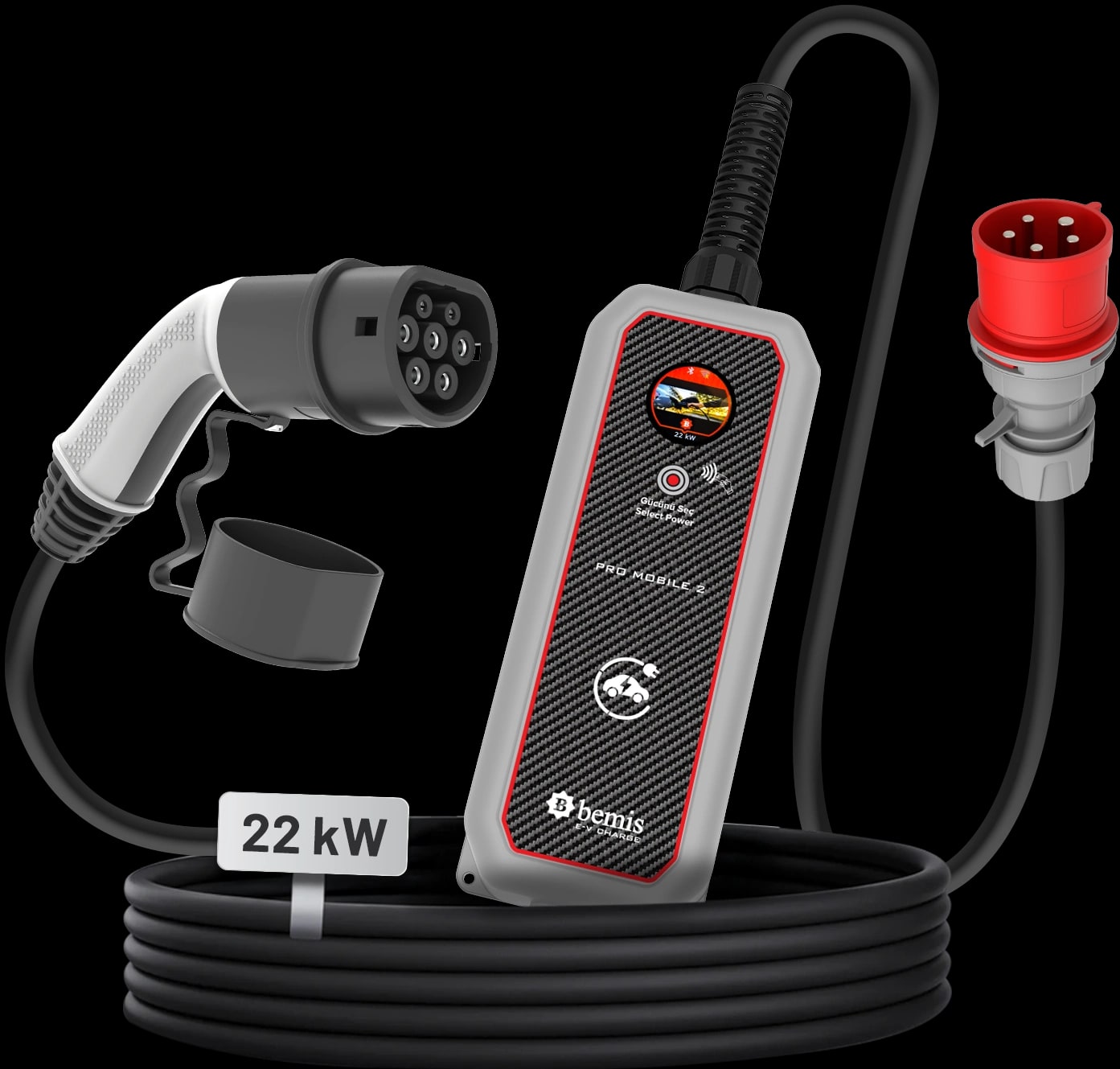
- Portable charger: plugs into a socket and travels in the boot. Its power depends on the socket it is plugged into — 3,7-7,4 kW on a single-phase socket, up to 22 kW on a three-phase industrial socket.
- Wall unit (wallbox): fixed installation, the tidiest and fastest route. Its power is adjustable and it can be managed with an app and an RFID card; the right choice for anyone charging at home every day.


Which charging cable for a Togg, and how many metres?
Because Togg uses Type 2, the socket type is not what decides the cable; what decides it is the current class and the length. Charging sets are made in four current classes: 16A single phase 3,7 kW, 32A single phase 7,4 kW, 16A three phase 11 kW and 32A three phase 22 kW. Choose the cable according to your car's ceiling and your home's wiring — the speed follows whichever of the two is lower.
- Length: sets are made in 3, 5, 7, 8 and 10 metres, and up to 15 metres in three-phase models. Measure the distance along the path the cable will follow, not in a straight line.
- With a device that has its own cable you do not need a separate one: the cable of the wall unit or portable charger already plugs into the car. A separate charging set is needed between a socketed station and the car.
- Carrying the cable coiled and clean protects the connector end; use a charging cable bag of the right size for that.
If a Togg will not charge at home
If charging does not start at home, the problem is usually not in the car itself but in the connection or the circuit. Check these in order: is the connector fully seated and locked in the socket; has the circuit fuse tripped; is the current step of the device below the capacity of the circuit; could a delayed, that is scheduled, charging setting have been left on in the car. If these steps do not help, do not interfere with the electrical installation or the inside of the device; contact an authorized service.
Tip: If you are on a multi-rate (night) tariff, set the timer on the device or in the car to the night period; on a battery of 50-85 kWh like a Togg the tariff difference is clearly visible on the monthly bill.
Drawing power out of the car (V2L) is a separate subject and is not available on every Togg model; we cover it in a separate guide.
Browse home charging stations (wallbox).
Home Charging StationsFrequently Asked Questions
Can a Togg be charged at home?
Yes. For AC charging Togg uses the Type 2 socket, the standard in Türkiye and Europe, so you do not need to look for a special socket type to charge at home. There are three ways at home: an ordinary domestic socket, a portable charger plugged into a socket or a charging set with Type 2 on both ends, and a wall-mounted home charging station. The ordinary socket is the slowest route and is not considered a permanent solution; if you will charge daily, a wall unit is both faster and tidier. Installation and circuit checks should be carried out by a qualified electrician.
How long does a Togg take to charge at home?
The time depends on the size of the battery and the power available at home. Taking the battery from 10% to 100%, losses included, takes about 21 h 44 min on an ordinary domestic socket for the 50 kWh Standard Range, 13 h 31 min at 3,7 kW, 6 h 45 min at 7,4 kW and 4 h 33 min at 11 kW. On the 85 kWh Long Range the same order is about 36 h 57 min, 22 h 58 min, 11 h 29 min and 7 h 44 min. On a T10X whose onboard charger is 22 kW, at 22 kW the times drop to 2 h 16 min and 3 h 52 min. In daily use it is rare to run the battery flat and fill it completely.
How many kW does a Togg charge at?
In AC charging the speed is set not by the device but by the car's onboard charger. Togg T10F has an 11 kW onboard unit from first production. On the T10X side the production period decides it: a T10X built between 2023 and 15 June 2026 has 22 kW, while production after 15 June 2026 has an 11 kW onboard unit. Because the standard value in current production is 11 kW, do not treat 22 kW as the default; check which one your own car has from the registration document and equipment list or through an authorized service.
Which charging cable does a Togg need, and how many metres?
Because Togg uses a Type 2 socket, what decides the cable is not the socket type but the current class and the length. Charging sets are made in four classes: 16A single phase 3,7 kW, 32A single phase 7,4 kW, 16A three phase 11 kW and 32A three phase 22 kW. Choose the cable according to the car's ceiling and the home's wiring; the speed follows whichever is lower. On the length side, sets are made in 3, 5, 7, 8 and 10 metres, up to 15 metres in three-phase models, and the distance is measured along the path the cable will follow. If you use a device with its own cable, a separate charging set is not needed.
If I buy a 22 kW charger for my Togg, will it charge faster?
Not unless your car's onboard charger is 22 kW. In AC charging the speed is set by whichever is lower, the power of the device or the car's onboard unit; a Togg with an 11 kW onboard unit will draw 11 kW even when connected to a 22 kW device and will get the time in the 11 kW row of the table. A 22 kW device also requires three-phase, 32A wiring; if your home circuit is not suitable the device cannot deliver that power anyway. The right approach is to choose the device according to the car's ceiling and the home's wiring, without moving up a class unnecessarily.
My Togg will not charge at home, what should I do?
The problem is usually not in the car but in the connection or the circuit. First check that the connector is fully seated and locked in the socket; if the lock does not engage, charging will not start. Then look at the circuit fuse and make sure the current step of the device stays below the capacity of the circuit. A delayed, that is scheduled, charging setting may have been left on in the car; in that case charging will not start until the planned hour. If these steps do not help, do not interfere with the electrical installation or the inside of the device, and contact an authorized service.
Featured Products
Solutions we manufacture in our own facility, related to this guide.

Let's choose the right product together
Not sure which product fits your vehicle and electrical installation? Get in touch and our authorised dealer or sales team will guide you.
- Manufacturing in our own facility since 1994
- CE-certified product family
- 2-year manufacturer warranty
- +90 (224) 433 02 16 sales@bemis.com.tr