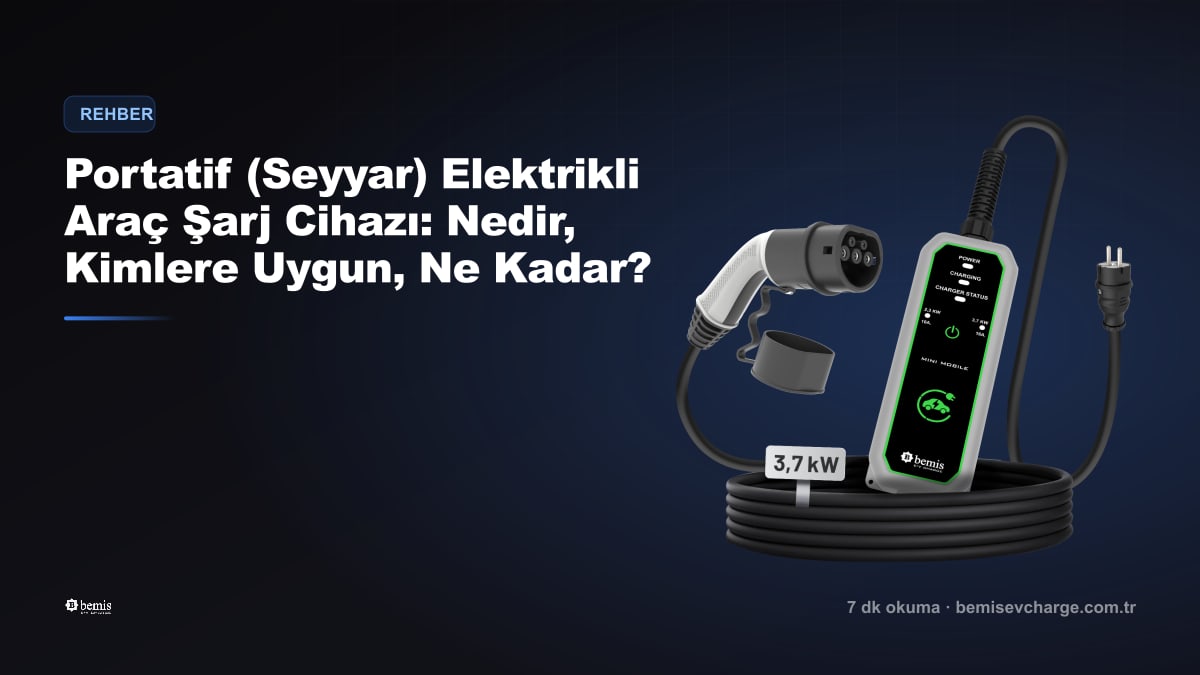
Portable (Mobile) EV Charger: What Is It, Who Is It For, How Much Does It Cost?
You have bought an electric car, but fitting a wall-mounted charging unit (a wallbox) at your home or in your garage is not always easy. You may be renting, your car park may be shared, or you may need to charge the car in different places. This is exactly where the portable (mobile) charger comes in: you take it out of its case, plug it into a socket and charge your car. In this article we explain in plain language what a portable car charger is, who it suits and what determines its price.
What is a portable (mobile) charger?
A portable charger is a car charging device that needs no fixed installation and that you can carry with you. Most models come with a carrying case, live in your boot and are plugged into a socket whenever you need them. "Mobile charger", "portable charger" or simply "charger" all describe the same product. That is the fundamental difference from the fixed charging unit mounted on the wall (the wallbox): one stays fixed on the wall and requires installation, the other travels in a case and is plugged into a socket.
Who is a mobile charger suitable for?
A portable charger is useful in almost every situation where fitting a fixed unit is difficult or unnecessary:
- Those who rent, or who cannot fit a fixed unit in their car park
- Those without a garage, who charge the car on the street or at various points
- Those who want a practical solution for places visited occasionally, such as a summer house, a second home or a village house
- Those who want to charge their car both at home and at work
- Professionals who need to charge at different locations, such as fleets, field teams and service crews
- Drivers who want to keep a spare charger in the boot for the road
Can a car be charged from an ordinary household socket? A safety note
Yes, with the most basic model you can charge from a standard household socket (Schuko); however, this is the slowest method and the one that calls for the most care. Charging a car keeps the socket under load for a long time, so sound, good-quality wiring is essential. Always use a device that has passed CE conformity testing and plug the device directly into the wall socket; avoid extension cables and multi-way (power strip) sockets, because they create a risk of overheating and fire. If your socket is old or weak, have it checked by a qualified electrician before you start charging.
Can I plug it in and use it myself?
This is the greatest advantage of a portable device: because the device itself is plug-and-play, you do not need an electrician to use it; you take it out of the case, plug it into a suitable socket and start charging. A wall-mounted wallbox, by contrast, requires a fixed installation, wiring and usually an electrician. The one exception is on the socket side: if an industrial (CEE) socket or a three-phase line is needed for charging at a higher power, that socket or line may have to be run by a qualified electrician. Plugging in and using the device is up to you; when infrastructure is needed, leave the job to an expert.
The Bemis portable charger models
Bemis's portable chargers come in three models, from the most basic household socket to professional three-phase use. All are produced in our own facility, pass CE conformity testing and carry an IP65 protection rating (resistant to dust and water). The table below summarises which model suits whom:
| Model | Power | Phase | Who it suits |
|---|---|---|---|
| Mini Mobile | 2.3–3.7 kW | Single-phase | Plugs straight into a standard household socket (Schuko); with a case, the most basic everyday use |
| Mono Mobile | 3.7–7.4 kW | Single-phase | CEE 16/32 A industrial socket adapters and a Schuko outlet; faster charging at home and at work |
| Pro Mobile 2 | 3.7 – 22 kW | Three-phase | CEE 5/16 A and 5/32 A adapters, 6 adjustable current steps; professional, fleet and field use |
- Mini Mobile: the simplest option, plugged straight into the ordinary socket at home (Schuko); comes with a carrying case.
- Mono Mobile: higher power on the single-phase side; adapts to different sockets with CEE 16/32 A industrial socket adapters and a Schuko outlet.
- Pro Mobile 2: designed for professional use, with 22 kW three-phase power (an 11 kW option is also available), CEE 5/16 A and 5/32 A adapters and current steps adjustable between 6/10/16/20/25/32 A.
See the details and technical specifications of the three models.
See the portable charging modelsHow much does a portable charger cost? What determines the price?
Let us be clear: a portable charger has no single "list price", because the price varies with your needs. Bemis gives its prices through its dealers, according to current conditions. So it is more accurate to look at the quotation drawn up for you rather than at the general figures you see online. The main factors that determine the price are these:
- Power (kW): higher power means faster charging and affects the cost.
- Single-phase or three-phase: three-phase models (for example the Pro Mobile 2) are more powerful.
- The adapter set: the range of extra socket adapters, such as Schuko and CEE 16/32 A, varies.
- Case and accessories: a carrying case and additional equipment may be included in the package.
- Brand, certification and warranty: CE conformity testing, IP65 protection and the assurance of manufacture in our own facility add lasting value.
In short, the answer to "how much?" depends on the model you choose and on your needs. For a clear, current price, it is enough to get a quotation from your nearest Bemis dealer.
Get a current price and quotation from your nearest dealer.
See the models for a price/quotationWhich model should I choose?
The choice really comes down to two questions: what socket do you have, and how fast do you want to charge?
- You only have the ordinary socket at home and a basic solution is enough: Mini Mobile.
- You want faster charging and can reach an industrial (CEE) socket: Mono Mobile.
- You need professional, fleet or field use and three-phase power: Pro Mobile 2.
If you are still undecided, you can look at our guide that helps you choose the right device step by step, or read our article comparing a fixed unit with a portable device.
Which charger suits you? We explain it step by step.
How to choose a charger for an EV?A fixed charging unit or a portable device? We compared the two.
Unit or portable?Frequently Asked Questions
What does a portable (mobile) charger mean and what is it for?
A portable charger is a charging device you can carry with you and plug into a socket to charge your car. It usually comes with a carrying case and lives in your boot; unlike the fixed units mounted on a wall (wallboxes), it needs no installation. "Mobile charger" and "portable charger" describe the same product. It lets you charge from different sockets at home, at work, at a holiday home or on the road. It is a highly practical solution especially if you rent, if you use a shared car park or if you cannot fit a fixed unit in your garage. That way you can charge your car comfortably wherever you need to, without being tied to a single point.
How much does a portable charger cost?
A portable charger has no single fixed price; the price varies with the model you choose and with your needs. The device's power (kW), whether it is single-phase or three-phase, the socket adapters that come with it (such as Schuko and CEE 16/32 A), the carrying case and the certifications are the main factors that determine the price. Even the same model can be priced differently with a different adapter set or accessories; so it is best to clarify your needs first and then ask for a quotation. Since Bemis gives its prices through its dealers according to current conditions, you will learn the most accurate and definite figure by getting a quotation from your nearest dealer. It is sounder to look at a personal quotation drawn up for your needs rather than at the general figures you see online.
Can a car be charged from an ordinary household socket?
Yes. The most basic model, the Mini Mobile, plugs straight into a standard household socket (Schuko) and charges your car. However, charging from a household socket is the slowest method and the one that calls for the most care; the socket stays under load for a long time. For that reason, use a good-quality device that has passed CE conformity testing and plug the device directly into the wall socket. Avoid extension cables and multi-way (power strip) sockets, because they create a risk of overheating and fire. If your socket is old or weak, having it checked by a qualified electrician before you start charging is the safest route. If you want higher power and faster charging, it makes more sense to look at models with an industrial socket or three-phase.
Which portable charging model should I choose?
The choice depends on the socket you have and the charging speed you want. If you only have the ordinary socket at home and a basic solution is enough, the Mini Mobile (2.3–3.7 kW single-phase) is suitable. If you want faster charging and can reach an industrial (CEE) socket, the Mono Mobile (3.7–7.4 kW single-phase) stands out. If you need professional, fleet or field use and three-phase power, the Pro Mobile 2 (11–22 kW, adjustable current) is the right choice. In short, the right model is shaped by how much power you need and which socket you have access to. If you are not sure, you can read our selection guide or consult your nearest Bemis dealer to determine the model that best suits your needs.
Can I plug in and use a mobile charger myself?
The device itself is plug-and-play; you take it out of the case, plug it into a suitable socket and start charging — that is, you do not need an electrician to use the device. A wall-mounted wallbox, by contrast, requires a fixed installation and usually an electrician. The one point to watch is the socket side: if an industrial (CEE) socket or a three-phase line is needed for charging at high power, that socket or line may have to be run by a qualified electrician. In short, plugging in and using the device is up to you; only if the right socket infrastructure is missing should you have the installation done by an expert. That way you can buy the device and start using it right away, and turn to an electrician for the socket side only when necessary.